


Insurance
Dec. 19, 2025
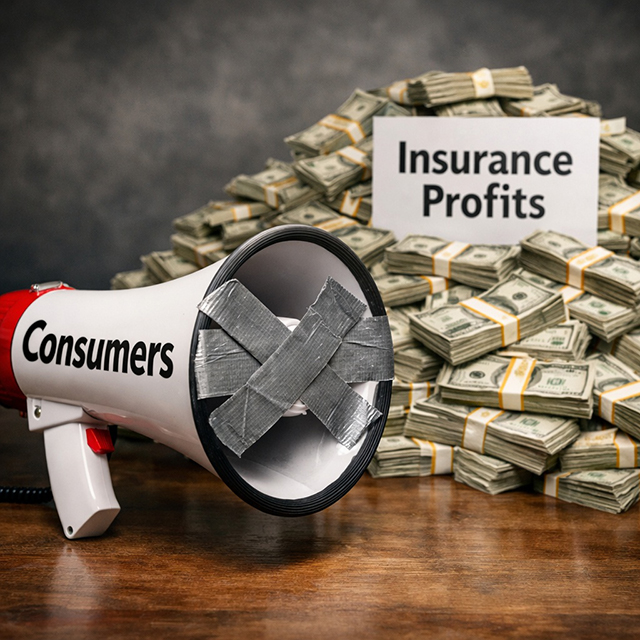
How California's insurance chief is quieting consumers to boost industry profits
California's insurance commissioner is gutting Proposition 103's consumer oversight, favoring insurers, and blocking advocates like Consumer Watchdog from holding companies accountable.


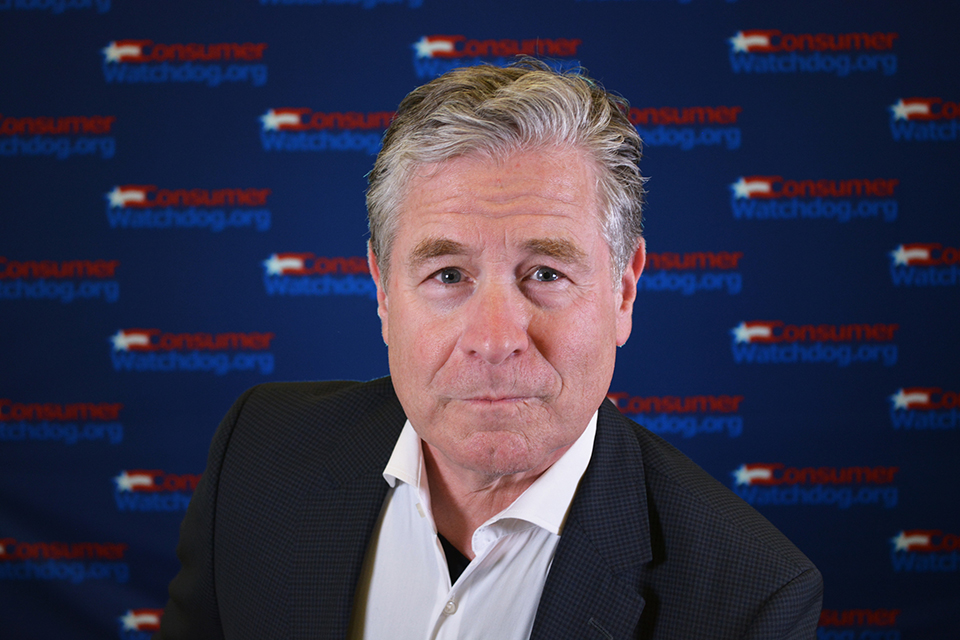
Harvey Rosenfield
Rosenfield is the founder of Consumer Watchdog and author of Proposition 103
6330 San Vicente Blvd. Suite 250
Los Angeles , CA 90048
Phone: (310) 392-0522
Email: harvey@consumerwatchdog.org
Georgetown University Law Center; Washington DC
California's insurance commissioner, Ricardo Lara, has
decided that giving consumers a voice in the regulation of insurance companies
is just too much accountability for himself and the industry he regulates.
After years of policy disagreements with consumer groups, Lara is now trying to
cancel a voter-approved system that enables Californians to independently
watchdog compliance with Proposition 103.
To protect their profits, insurance companies deploy an
army of lawyers, lobbyists, and experts--just ask
anyone whose home burned in the LA wildfires what it's like trying to get their
insurer to pay a claim. Policyholders ultimately foot the bill for the
industry's vast legal apparatus. When Californians passed Proposition 103, they
knew that insurers would aggressively resist its reforms, which include
regulation of rates and a bar on discriminatory practices that were previously
commonplace. They sought to redress the imbalance of power between the industry
and consumers by enabling the public to challenge an insurer or the
commissioner in any administrative or judicial forum and, crucially, by
requiring insurance companies to pay consumer advocates their reasonable legal
fees and expenses when they make a "substantial contribution" to the outcome of
the challenge. (Ins. Code § 1861.10.)
Consumer Watchdog has invoked this process to defend
Proposition 103 against industry lawsuits, of which there have been hundreds
since the initiative's passage; enforce Proposition 103's protections against
profiteering and discrimination; provide expert testimony on complex regulatory
matters before the California Department of Insurance; and block over $6 billion
in unjustified rate increases since 2003. For every $100 the non-profit
organization has saved people on their residential, auto, and small business
premiums, the cost to policyholders of compensating Consumer Watchdog's
advocates in rate proceedings has averaged 25 cents.
No other state in the nation offers its citizens this
ability to participate directly in the government's regulation of insurance,
and the industry has constantly sought to undermine it. Commissioner Lara's
response to California's current insurance crisis has only emphasized its
importance.
Insurance companies have seized on climate change as an
excuse to argue they can no longer comply with Proposition 103's consumer
protections. To press their point, they have sought massive rate increases and
abandoned homeowners in neighborhoods across the state. Their demands: diminish
scrutiny of insurers' applications for higher rates; allow them to use secret,
potentially biased software algorithms to set premiums; permit the companies to
pass through unregulated expenses to their customers; and, finally, terminate
the public participation process. Do all this, the industry threatened, or face
even more chaos in the insurance marketplace.
Lara capitulated (with the backing of Gov. Newsom), and in
2024 began rewriting long-standing regulations. Consumer Watchdog intervened in
each rulemaking proceeding, thoroughly critiqued each proposal (many of which
were poorly drafted), and urged specific changes to
protect consumers. The commissioner ignored our input.
In 2023, Lara promised that once the public paid the
insurers' ransom, his new rules would require them to resume selling insurance
in areas they'd abandoned. But, as Consumer Watchdog explained, that quid pro
quo was riddled with loopholes that incentivized
companies to dump policyholders. By the time Lara's promise took effect
in 2025, 300,000 more policyholders had been forced to buy high-priced, low
coverage policies from the FAIR Plan, California's "insurer of last resort." So insurance companies got the
deregulation and price increases they extorted, but for "$341 million in
combined annual hikes, the state would gain 8,111 policies over three years,"
the LA Times calculated.
Lara delivered his final gift to the industry three months
ago: a plan to demolish the public participation process. His proposal allows
him to retroactively deny compensation for consumer advocacy if he claims the
advocacy is "vexatious," "duplicative," "cumulative," "peripheral,"
"oppositional" or merely "irrelevant," or if he says that the intervenor has an
"ideological agenda." It caps the number of lawyers for whom a consumer
advocacy group can be compensated to two, while placing no limits on the number
an insurance company can hire at policyholder expense. It eliminates the
ability of independent Administrative Law Judges to oversee most rate matters
and transfers consumer compensation requests from them to himself--a Trump-style
power grab that completes a coup Lara began with the abrupt removal of the
agency's chief judge last winter.
Lara insists that his Department of Insurance employees
adequately protect consumers; the statistics disagree. When there was no
consumer oversight, Lara approved an average of 95% of the increase requested
by home insurers from January 2022 to April 2025, and 89% of the increase
requested by auto insurers. But when Consumer Watchdog participated, the
percentage of the rate increase approved in homeowner insurance cases dropped
to 75%. In auto insurance cases, it was 65%.
Indeed, his staff has dutifully implemented Lara's
pro-industry policies. In February of this year, agency lawyers signed off on
an "emergency" $1 billion financial bailout for State Farm without even
requiring the company to justify it at a public hearing--a violation of Prop.
103. After Consumer Watchdog objected, Lara belatedly ordered a hearing but
approved an "interim" rate increase of $749 million in the meantime. Consumer
Watchdog is currently fighting a team of State Farm lawyers (and the Commissioner)
in an administrative court to force the company to either prove it's entitled
to that handout or refund the money.
Lara has made little effort to hide his scorn for
Proposition 103, or that his amendments to the current rules governing public
participation target Consumer Watchdog, his most persistent critic and the
insurance industry's nemesis. As one columnist concluded: "Mainly, this is an
effort to squelch or silence Consumer Watchdog.... That nonprofit is the
preeminent intervenor in insurance rate proceedings."
The Consumer Federation of California Education Foundation--another
intervenor--and dozens of other organizations have urged Lara to withdraw his
plan, which in its present form unequivocally conflicts with Proposition 103's
text and purposes. It also flouts a fundamental norm: that of equal justice
under law. As the Consumer Attorneys of California points out in a letter to
Lara, his draft regulation "can be read to suggest that strenuous advocacy on
behalf of consumers is unwelcome and improper. It is a singular principle of
American law that the best way to determine truth is through the competition of
opposing arguments." Lara's proposal would silence consumers, denying
Californians the representation to which they are entitled and weighting the
scales of justice in favor of the insurance companies.
Submit your own column for publication to Diana Bosetti
For reprint rights or to order a copy of your photo:
Email
Jeremy_Ellis@dailyjournal.com
for prices.
Direct dial: 213-229-5424
Send a letter to the editor:
Email: letters@dailyjournal.com