

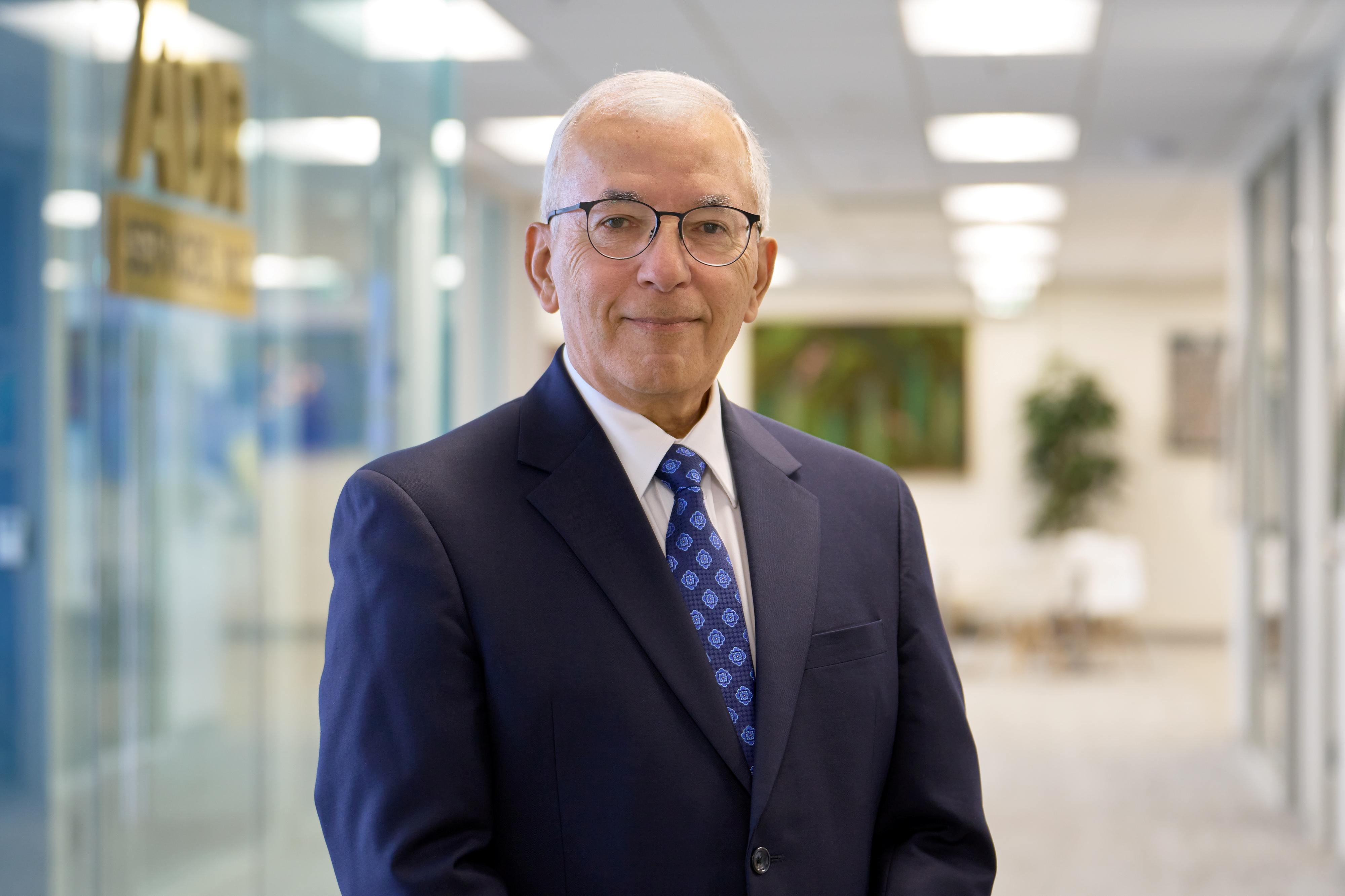
Career Highlights: Served on Alameda Superior Court 1990-2017.
Law School: UC Hastings
ADR Services
Employment, real property, professional malpractice, commercial litigation and personal injury
Decades after playing soccer for UC Berkeley, retired judge George C. Hernandez still brings a competitive spirit to his work as a private neutral. But these days, the contests are more cerebral than physical.
"You don't have to love your teammates. In fact, very often, you hate your teammates, but you work together," Hernandez said with a chuckle, recalling his days on the soccer pitch. "And the other side - you run into them and you knock them down, but you pick them up, so you can knock them down again."
The analogy extends only so far, he added. His spirited exchanges with attorneys during mediations are never personal.
"It's more competing mind to mind as opposed to knocking them down," he said with a laugh.
Hernandez spent more than three decades on the bench, first as a commissioner and municipal court judge and later on the Alameda County Superior Court. After retiring in 2018, he joined ADR Services, Inc., where he handles employment, real property, professional malpractice, commercial and personal injury disputes.
Although arbitrations now outnumber mediations on his calendar, Hernandez said much of his work still involves helping parties reach settlements before a hearing becomes necessary.
"But I spend probably 80% of my time doing mediations," he said. "And the arbitrations I monitor, making sure they're all focusing on resolving the matter in the end."
When arbitration does proceed to a hearing, Hernandez brings a decidedly judicial approach to the evidence.
"In theory, in arbitration you can be very flexible when it comes to evidence - the evidence code doesn't necessarily apply directly. I don't know how to do that," he said with a chuckle. "I only know evidence. That's my first language. I learned it in law school. I don't know how not to do evidence."
He takes objections involving foundation and hearsay seriously, even when arbitration rules permit greater flexibility.
"I just know what the evidence code is," he said.
Half Moon Bay defense attorney John P. Boggs, who has used Hernandez as an arbitrator in several employment disputes, described him as "an absolute gem" whose evenhandedness makes his decisions difficult to predict.
"You have no idea what he's thinking until you get his decision," Boggs said. "In other words, it is that middle of the road and fair to both sides."
Boggs said Hernandez also maintains his composure when attorneys make mistakes or discovery disputes become contentious.
"He never flies off the handle - even if maybe you made a bad decision in discovery responses, and he has to rule on it," Boggs said. "He never does anything to make either side feel like he's being punitive."
As a mediator, Hernandez said his approach has evolved over the past eight years toward a more evaluative style. Rather than simply carrying settlement demands between opposing parties, he draws on his judicial experience to challenge assumptions and explore what is driving a dispute.
"I think it's important for the attorneys to benefit from the years and the experience neutrals have," he said. "I think my value is giving them access to all the years and all the stories I was able to create and to gather together."
That means asking questions that go beyond the numbers.
"Instead of just listening and saying, 'OK, now you want X amount of dollars, and you want Y amount of dollars,' I ask them, 'Why did you file this case? What were you thinking at the time?'"
San Francisco plaintiffs' attorney Shounak S. Dharap, who appeared before Hernandez in Alameda County Superior Court and has since retained him to mediate wrongful death, elder abuse and employment disputes, said the retired judge excels at identifying what parties really need to reach an agreement.
"Judge Hernandez is really good at figuring out exactly what the parties want," Dharap said. "He's very good at getting to the heart of what exactly is motivating each of the parties to try and reach an agreement."
Those motivations often extend beyond financial compensation, Dharap said. Anger, grief and other emotional considerations can become significant obstacles to settlement.
"There can be an emotional aspect to it on either side of the v that is so important to understand in order to actually get to the heart of a resolution," he said. "And Judge Hernandez is so incredibly empathetic that he's able to really talk to the parties and understand what it's going to take to resolve the case."
San Francisco defense attorney Maria C. Kao, who has used Hernandez extensively in homeowners' association disputes, agreed that his patience and empathy are among his greatest strengths.
"He just brings a nice approach to a dispute, where someone may be very emotional and hard to communicate with," Kao said.
Homeowners' association litigation can be especially contentious because the disputes often involve neighbors, personal relationships and deeply held grievances. Kao said Hernandez is particularly effective when emotions threaten to overwhelm the legal issues.
"The thing about human emotion is that it is not rational, and it doesn't always make sense," she said. "So if you need someone to kind of work through some of that because it is distracting from a final resolution, that's where I think Judge Hernandez may be a good choice."
Boggs said that ability to defuse tensions, combined with Hernandez's respect for attorneys and litigants, makes him equally effective in employment mediations.
"No matter how bad your case is or how good it is, both sides know that he respects you," Boggs said. "There are no personal attacks like you see sometimes with these judges, who get cranky and think they're always right. Judge Hernandez is not that way."
Instead, Boggs said, Hernandez has a knack for calming adversaries and keeping them focused on resolving their differences.
"He always has a way of calming both sides and just working through the issues."
Here are attorneys who have used Hernandez's services: John P. Boggs, Fine Boggs & Perkins LLP; Maria C. Kao, Briscoe Prows Kao Ivester & Bazel LLP; Shounak S. Dharap, Arns Davis Law; Michael R. Reynolds, Rankin, Shuey, Mintz, Lampasona & Harper; Ashley E. Klein, Nixon Peabody LLP.