


Alternative Dispute Resolution
Apr. 15, 2026
AI in ADR: Ethical innovation or disruption?
See more on AI in ADR: Ethical innovation or disruption?California's push to rein in AI in arbitration could make AAA's AI Arbitrator off-limits, forcing human arbitrators to keep a firm hand on every decision.


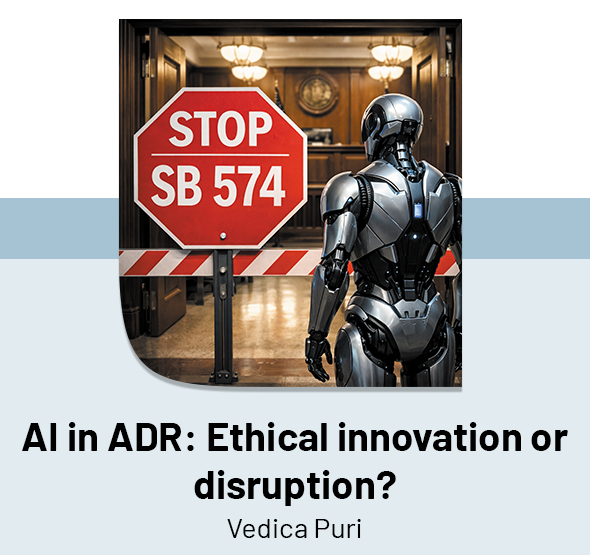
Two things can be true at once: a program such as AI Arbitrator, which is certainly at the forefront of legal innovation, can also be disruptive. But such game changes are here to stay and must navigate tricky terrain that may vary state to state.
The AI arbitrator enters the scene
You may have heard of the panoply of AI platforms made for the legal industry: Harvey AI (named after the lead character from the TV show "Suits"), Lexis+ AI, Co-Counsel, to name just a few. But in a true first, AAA introduced "AI Arbitrator" at the end of last year. It is exactly what it sounds like: an AI program that acts like an arbitrator and is designed to generate an arbitration award. The current version is restricted to law value construction cases based on only documents. The tool won the 2026 Edison Award for Ethical AI for Society., named after Thomas Edison.
Human oversight remains throughout the process, with the parties reviewing the claims summary and a real arbitrator reviewing the draft award. Once the parties agree and only if they agree to use the AI Arbitrator, documents can be uploaded to AAA's case management platform. The program then summarizes and analyzes the claims at issue and documents provided. The parties are allowed to comment on that output. The AI Arbitrator then does what a human arbitrator would--applies the law to the facts based on the evidence in the documents and prepares a recommended arbitration award.
AAA has put together a series of short videos to explain its new product. In these videos, AAA explains that AI Arbitrator is based on construction arbitration awards generated in prior AAA cases and does not reach out to any internet or public sources as it works. That is a key guardrail to ensure the integrity of any results, according to AAA. Once the award is prepared by AI Arbitrator, a human arbitrator reviews, edits and remains responsible for the decision by signing it. Obvious benefits include saved time and money. AAA estimates the time to resolve a low budget construction case without any live witnesses would be cut in half (from 60-75 days to 30-45 days).
The California complication
A proposed California law that could become a reality this year would render AI Arbitrator virtually unusable. The applicable language of SB 574, which would add a new section to the Code of Civil Procedure (among other things), reads in relevant part:
SEC. 3.
Section 1282.1 is added to the Code of Civil Procedure, to read:
1282.1.
(a) (1) An arbitrator shall not delegate any part of their decision-making process to any generative artificial intelligence tool.
(2) The use of generative artificial intelligence tools by arbitrators shall not replace their independent analysis of the facts, the law, and the evidence.
(3) An arbitrator shall not relinquish their decision-making powers to generative artificial intelligence and shall avoid delegating any tasks to generative artificial intelligence tools if such use could influence procedural or substantive decisions.
(b) (1) An arbitrator shall not rely on information generated by generative artificial intelligence outside the record without making appropriate disclosures to the parties beforehand and, as far as practical, allowing the parties to comment on its use.
(2) If a generative artificial intelligence tool cannot cite sources that can be independently verified, an arbitrator shall not assume that such sources exist or are characterized accurately.
(c) An arbitrator shall assume responsibility for all aspects of an award, regardless of any use of generative artificial intelligence tools to assist with the decision-making process.
(d) For purposes of this section, "generative artificial intelligence" means an artificial intelligence system that can generate derived synthetic content, including text, images, video, and audio that emulates the structure and characteristics of the system's training data.
SB 574 imposes new duties for arbitrators, prohibiting them from delegating any decision-making to AI tools. If enacted as written, California-based arbitration cases could not use the AAA's AI Arbitrator, and individual arbitrators would not be permitted to delegate important decision-making tasks to AI tools.
The proposed law also seems to take aim at arbitrators using AI programs for legal research, requiring them to disclosure to the parties whenever they rely on AI-generated information.
SB 574 passed the California Senate unanimously this past January and will next be considered by the Assembly. A timeline for action has not yet been announced, so stay tuned.
Vedica Puri is a mediator at ADR Services Inc., a former San Francisco County Superior Court judge who presided over civil trials, mandatory settlement conferences, law and motion, and probate matters, and previously a trial attorney.