


Alternative Dispute Resolution
Apr. 15, 2026
Attorney-client confidentiality melts away when AI enters the room
See more on Attorney-client confidentiality melts away when AI enters the roomAs attorneys increasingly use AI in mediation, a key federal ruling warns that client use of public AI tools may waive privilege, underscoring the need for careful oversight to protect confidentiality.


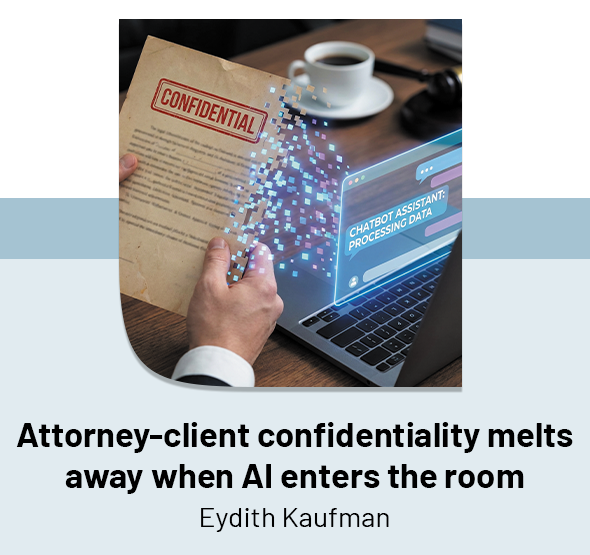
Attorneys are increasingly using AI to draft briefs or arguments for mediation. Warnings about the consequences of AI misuse have become ubiquitous for those practicing law, with a focus on sharing too much with AI or relying too heavily on AI-generated content. Most attorneys understand the need to be cautious about using AI to input sensitive or confidential client data, but what happens when your client uses AI to generate a timeline or set of facts intended for your eyes only?
Like most things in life, it may depend. In one of the first judicial decisions addressing attorney-client privilege associated with AI platforms, a federal judge in the U.S. Southern District of New York ruled in United States v. Heppner (25-cr-00503-JSR, Feb. 17, 2026) that documents generated using a publicly available AI tool are not shielded by attorney-client privilege or the work product doctrine.
The Heppner case
During the execution of a search warrant on Heppner's property, federal agents seized electronic devices containing both the AI-generated documents and the underlying interaction logs showing Heppner's prompts to the AI platform. Heppner asserted privilege, describing the materials as "artificial intelligence-generated analysis conveying facts to counsel for the purpose of obtaining legal advice."
The judge found otherwise, ruling that by entering sensitive information into a consumer-grade, public version of an AI tool entirely on his own initiative, without any direction, supervision, or involvement from his attorneys, Heppner had voluntarily disclosed that information outside the attorney-client relationship. The court noted that the AI company's terms of service and privacy policy explicitly permitted data collection, retention and use for model training purposes, negating any reasonable expectation of confidentiality.
The judge also found that even though Heppner eventually shared the AI-generated documents with his attorneys, this subsequent disclosure to counsel could not cure his earlier waiver of privilege. The privilege, the judge ruled, must exist at the time of communication.
What Heppner means for California attorneys
Heppner highlights for California attorneys, particularly those practicing in federal courts, the potential risks of using publicly accessible, consumer-grade AI tools in legal contexts. The exact scope of Heppner is unclear given that it was a unique case.
Notably, Heppner involves a criminal defendant, one who used public, free AI on his own and only later provided the work to his attorney. The ruling in Heppner thus does not strip privilege from all communications involving generative AI; it merely confirms that attorney-client privilege attaches only to confidential communications made to an attorney and solely for the purpose of the solicitation of legal advice.
While not holding that attorney-client privilege is de facto waived by using public AI, the Heppner ruling may nonetheless impact an attorney's use of information obtained by the client if it was prepared with AI, especially if done before the lawsuit or representation commenced.
Another federal case, out of the Eastern District of Michigan, Warner v. Gilbarco (No. 2:24-cv-12333 (E.D. Mich. Feb. 10, 2026)), held that defendants could not compel discovery about a pro se litigant's use of AI during litigation, after discovery had closed. The court found this use of AI was protected by the work product privilege, holding that it was not a method likely to disclose information to an adversary; the use of AI to aid the pro per's legal analysis was protected work product. Unlike Heppner, in which the AI analysis was not done at an attorney's behest, the self-represented litigant in Warner was acting as counsel, using AI as a drafting tool.
Protecting privilege
These cases underscore the importance of ensuring that there is no waiver of attorney-client or work product privilege by attorneys, as well as by consultants or clients who choose to use AI. Direction from counsel may make a difference when a court must decide if a client's use of AI is protected, as will the expectation of confidentiality for the AI product --i.e., public, open AI versus fee-based, closed-loop AI.
Most document management systems, email platforms, and legal research databases utilized by attorneys involve third-party servers, but they remain subject to privilege because confidentiality is maintained through contractual and technical safeguards. As long as AI is used under attorney direction with secure tools designed to preserve confidentiality, privilege should still be viable.
On March 19, the Committee on Professional Responsibility and Conduct of the California State Bar (COPRAC) issued "COPRAC Advisory Regarding Artificial Intelligence (AI) Hallucinations." While acknowledging the usefulness of AI tools, the advisory states that "attorneys must use them in a manner consistent with their duty of competence (rule 1.1), diligence (rule 1.3), and responsibilities as managerial and supervisory lawyers (rule 5.1)."
"Attorneys with managerial or supervisory authority must also implement reasonable policies, training, and oversight to ensure that any use of generative AI by attorneys does not compromise client confidentiality," according to the advisory. Although the State Bar's focus is on making sure attorneys' use of AI does not compromise confidentiality, the Heppner decision should cause California attorneys to recognize that client use of AI might also compromise attorney-client privilege.
What Heppner means in the mediation context
Heppner tells us that information shared with public AI platforms may be discoverable, with no privilege to shield it. In the mediation context, counsel should be cautious about a client's use of publicly available AI tools to prepare timelines of events, draft case narratives or conduct basic legal research that will ultimately be used in a confidential mediation brief.
Until there are California rulings expressly addressing generative AI and preservation of attorney-client and attorney work product privileges, AI used by clients for any mediation-related activity should be closed-loop products whose use is directed and overseen by the attorney. This should help ensure that confidential information remains confidential.
Eydith Kaufman is a neutral at Alternative Resolution Centers.