


Criminal
May 5, 2026
California lawmakers push funding boost as public defense system nears 'breaking point'
Officials cite staffing shortages, rising caseloads, and inequities as they seek $15 million annually for indigent defense


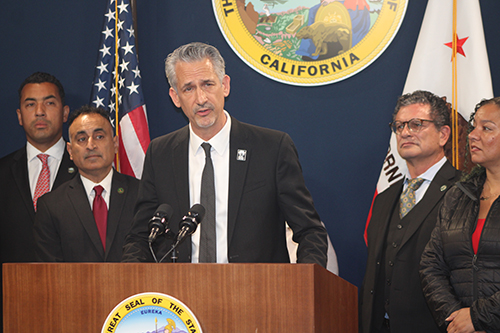
SACRAMENTO -- California lawmakers and public defenders called on the state to approve a $15 million annual budget request to fund indigent criminal defense, warning that the state's constitutional promise of legal representation for the poor is at a breaking point.
"California is facing an escalating recruitment and retention crisis in public defense," Assemblymember Ash Kalra, D-San Jose, said at a news conference near the Capitol on Monday. "It is more important than ever, especially given what we are seeing nationally, that we ensure that California sets the model as to what it means to have a judicial system that can be trusted. You can't do that without a public defense system that is supported."
He was flanked by 18 public defenders from throughout the state, including San Francisco Public Defender Mano Raju, who has been fighting his court for months over his refusal to take on more cases than he thinks his office can handle within constitutional limits. In March, the court held him in contempt for refusing to accept new clients, citing a "staffing crisis" within his office.
Kalra first introduced the proposal in March, along with a resolution to "affirm the fundamental importance of indigent defense to due process, equal justice, and democratic governance." The resolution also calls for broader statewide strategies to ensure sustainable funding and staffing levels. California is unusual among U.S. states in not providing stable statewide funding for public defenders.
ACR 159 passed the Assembly Public Safety Committee last month. That committee's chair, Assemblymember Nick Schultz, D-Burbank, is a former prosecutor and was one of the speakers on Monday.
"It is the first of many steps that we need to take to ensure that we have a justice system that gets it right more often than it gets it wrong, and a justice system that we can be proud of," Schultz said.
Not all prosecutors agree with him. Last year, California District Attorneys Association's CEO Greg Totten criticized lawmakers for including additional money for public defenders while, in his view, providing insufficient funding to Proposition 36, a measure approved by voters in 2025 that rolled back some criminal justice reforms of the past decades.
Public defenders around the state have complained of mounting caseloads, driven by factors including Proposition 36 and a law Kalra authored, the Racial Justice Act. They also say limited resources and declining financial incentives -- including cuts to federal student loan relief programs -- are driving young lawyers away from public service. Kalra, a former public defender, said the funding would help attract early-career attorneys and sustain the workforce needed to uphold constitutional rights.
The Sixth Amendment guarantees legal counsel to those who cannot afford it, a principle affirmed by the U.S. Supreme Court in 1963. But speakers at the event emphasized that merely appointing an attorney is not enough if defenders lack the time and resources to effectively represent clients.
Damon Silver, Santa Clara County's chief public defender, said the system has reached a "breaking point."
"Eighty percent or more of the clients in the system in California require the services of public defenders because they are poor," Silver said, adding that a large share are also people of color and many remain in jail awaiting trial. "When do we say enough is enough?"
Silver and others argued that chronic underfunding undermines fairness and public trust in the justice system, calling for sustained investment at both the state and national levels.
Assemblymember Sade Elhawary, D-Los Angeles, said she represents communities heavily impacted by poverty and over-policing. She said underfunded defense services contribute to burnout among attorneys and weaken outcomes for defendants.
"It is unfair that the state does not fund public defense at the same rate as prosecution," Elhawary said. "People who cannot afford a lawyer still deserve... an attorney who can give their full attention."
Los Angeles County Public Defender Ricardo Garcia echoed those concerns, highlighting what he called a structural imbalance in funding. His office -- the largest in the nation -- receives only partial support from county funds and competes for limited resources compared to prosecutors and law enforcement.
"Public defenders protect one of the most fundamental constitutional rights," Garcia said. "But recognition must be matched with investment."
Malcolm Maclachlan
malcolm_maclachlan@dailyjournal.com
For reprint rights or to order a copy of your photo:
Email
Jeremy_Ellis@dailyjournal.com
for prices.
Direct dial: 213-229-5424
Send a letter to the editor:
Email: letters@dailyjournal.com