


Military Law
May 6, 2026
How did Japanese baseball players get so good at 'America's Game?'
At least some of the credit may belong to the U.S. military and its veterans.


4th Appellate District, Division 3
Eileen C. Moore
Associate Justice
California Courts of Appeal
Walt Whitman is credited with calling baseball "America's game" in 1889. Yet, Hideo Nomo was born in Japan and didn't move to the U.S. until he was 26 years old. He was the 1995 National League Rookie of the Year. Ichiro Suzuki was also born in Japan and moved to the U.S. when he was 27 years old. He was inducted into the Baseball Hall of Fame four years later. Hideki Matsui, likewise born in Japan, moved to the U.S. when he was 28 years old. He was the 2009 World Series MVP. Shohei Ohtani, winner of four MVP awards and also born in Japan, was 23 years old when he signed with the Los Angeles Angels and moved to the U.S. in 2018. Yu Darvish, born in Japan as well, moved to the U.S. when he was 26 years old. Darvish is a five-time MLB All-Star. And there are many more!
Add to all that the fact that only one country has ever won the World Baseball Classic more than once. Japan won it three times! The last time, three years ago, Ohtani struck out his then-Angels' teammate, three-time American League Most Valuable Player and nine-time winner of the Silver Slugger Award, Mike Trout, to secure the WBC championship for Japan, defeating USA. About Ohtani, the Los Angeles Times wrote: "Never has modern baseball seen a talent like him."
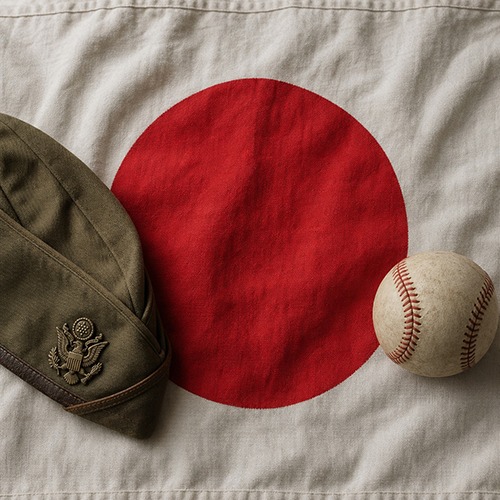
How did these players, born and bred in Japan, become so proficient at "America's Game?" The United States military and its veterans might have had something to do with this phenomenon.
As part of Asian American and Pacific Islander Heritage month, let's explore the connection between American G.I.s and baseball in Japan.
Foot in the door: Commodore Matthew C. Perry
Included in a diplomatic mission to reopen trade with Japan undertaken by the United States, Commodore Matthew C. Perry, a naval officer, took his fleet of gunships to Japan in 1853 and delivered a letter from President Millard Filmore for Emperor Kōmei. The letter asked that stranded American sailors be treated with respect. In addition, the letter requested the opening of trade relations between the two countries. Perry also brought gifts from the United States, including a working model train, a telescope and a telegraph, which were designed to show off American technology.
In 1854, the nations signed the Treaty of Kanagawa. The treaty secured protections for American sailors and opened two Japanese ports for refueling and resupply. More importantly, the treaty gave the United States favored-nation trade status, which provided the basis for future trade with Japan.
The beginning of baseball
Meanwhile, back in the States, baseball was evolving. It developed incrementally from various forms of games. The current form grew into a modern sport in Philadelphia, Boston and New York in the early 19th century. In 1854, New York's most prominent clubs, led by a team known as the Knickerbockers, had begun to codify basic rules.
Baseball taken to Japan by Civil War veterans
Between 1868 and the end of the century, Japan recruited over 3,000 foreigners known as oyatoi from Europe and the United States in an initiative to rapidly modernize itself. The United States sent hundreds of oyatoi to Japan.
The American identified as the pioneer baseball instructor was a 28-year-old Civil War veteran, Horace E. Wilson, who took his family to Japan to teach at a boys' academy. During recess and after school hours, Wilson taught baseball to Japan's best and brightest. Male fellowship through athletic activity was a new experience in Japan. By the time Wilson completed his second three-year contract and returned to the United States, baseball had established a dedicated following among both students and curious spectators who thronged the school's newly opened playground every Saturday.
Another Civil War veteran and West Point graduate, Leroy Lansing Janes, taught Western studies at a different Japanese school. He tried to instill the notion of a healthy life in his Japanese students through exercises styled after military calisthenics and baseball.
One of the big problems for baseball in Japan during those early years was the lack of equipment. One player took apart a ball and ordered his neighborhood shoemaker to study it and create an imitation. Kendo masks, used in Japanese sword fencing, were substituted for catcher's masks. Upholstered railroad car material was used for protective gear.
A solution toward solving the equipment problem came as a result of a Japanese father who was exasperated by his 15-year-old son's behavioral problems, and shipped him off to Boston in 1871. While in Boston, Hiroshi Hiraoka, who is now known as the father of Japanese baseball, became an avid Boston Red Stockings fan and gained acquaintance with Albert G. Spalding. Spalding, who learned baseball from a Civil War veteran, was then a Red Stockings ace pitcher who would soon become a principal mover of American professional baseball as a club owner and equipment manufacturer. When Hiraoka returned to Japan to work for a railroad company, he brought baseball equipment with him. He taught baseball to the railroad bureau's managerial staff after hours.
Playing baseball with American sailors
During the 1870s, visiting U.S. Navy ships provided opportunities for the Japanese to play baseball with American sailors as a result of the growing U.S. presence in the western Pacific in the late 19th century.
On July 4, 1876, as part of the nation's centennial celebration, there occurred a major breakthrough surrounding baseball in Japan. There was a game between the Tokyo All Stars and the baseball team of the battleship Tennessee, and the All Stars beat the vaulted Navy team.
Games between sailors and Japanese players, mostly students, continued for decades. Sometimes the Americans won and quite often the Japanese won.
A four-game series against American servicemen in the summer of 1896 generated passions throughout Japan. They received blaring coverage in the popular press and revealed not only baseball's flourishing significance as a cultural vessel of national identity but also its growing acceptance as a spectator vehicle of recreation and entertainment in Japan.
In 1907, President Theodore Roosevelt's Great White Fleet had a practice cruise in the Pacific Ocean. While the fleet was anchored in Japan, the crews of the Wisconsin and the Ohio played against Japanese teams in the "Pacific Series." Each side won some and lost some. After the games, the sides congratulated each other on their shared good sportsmanship and love of baseball.
Future service member in Japan pre-World War II
During the pre-World War II decades, American and Japanese baseball teams routinely played each other in cultural exchange games. In the fall of 1934, Cleveland Indians player Moe Berg, who had formerly played for the Washington Senators, played baseball in Japan.
Berg would later serve as an intelligence officer during World War II. But in 1934, he was possibly an undercover agent for the United States government while he was in Japan playing baseball.
As a Princeton University and Columbia Law School graduate, Berg was one of the most erudite major leaguers of all times. He mastered multiple languages, including Japanese. His proficiency in the language made Berg immensely popular with the Japanese baseball fraternity and press.
While in Japan, Berg went to the roof of a hospital, one of the tallest buildings in Tokyo. Using a 16mm Bell and Howell movie camera, he panned the surrounding skyline and recorded the city's industrial and harbor areas. Those images were later used in mapping the flight path of the famous 1942 bombing raid on Tokyo by Lieutenant Colonel Jimmy Doolittle.
Army military police were the guards while baseball was played in the internment camps
Baseball was extremely popular with America's Japanese populace. In fact, on Dec. 7, 1941, the day the Japanese attacked Pearl Harbor, the "Pride of Little Tokyo" was playing against a semi-pro team sponsored by the Paramount movie studio, when FBI agents arrived. The government agents did not interrupt the game. After the Paramount team won, the agents summarily surrounded the Nisei players, who were the sons of parents who emigrated from Japan. The FBI took them in for questioning and later released them without charging them.
Three months later, President Franklin D. Roosevelt signed Executive Order 9066. Virtually the entire Japanese and Japanese American populations of California, Oregon and Washington were forcibly relocated to internment camps. Army military police guarded the camps.
Almost immediately, with the Army's consent, the internees cleared land for baseball diamonds and built wooden grandstands, many times in the middle of barren deserts. Baseball became a way to sustain a sense of community, a semblance of normal life behind barbed wire.
At Tule Lake in northeastern California, volunteers cleared one area of rocks and seashells and used food-delivery trucks to haul in dirt from the camp farm. The baseball players ordered their jerseys from a Sears catalog and women made pants out of bleached potato sacks.
At Manzanar in the Mojave Desert, the internees loaded decomposed granite onto a dump truck and packed it in the dry ground with shovels to create a building surface for dugouts and wooden bleachers.
At Gila River, the camp inhabitants cleared sagebrush with shovels and leveled the ground with a bulldozer. They took out every other four-by-four of the fence surrounding the camp and built a backstop, a grandstand and bleachers.
In Minidoka alone, there were 14 different baseball fields located throughout the camp.
The spectators to these games always included soldiers with the United States Army's military police, who watched from armed guard towers above as interned Japanese and Japanese Americans played baseball.
The Supreme Commander for the Allied Powers and baseball
After the Japanese surrendered on Aug. 15, 1945 and until the allied occupation of Japan ended in April 1952, Japan was under the authority of the Supreme Commander for the Allied Powers, SCAP. General Douglas MacArthur was in command. And baseball was at the center of MacArthur's approach toward guiding the Japanese away from a warrior mentality.
The postwar era saw baseball as Japan's democratic officially sanctioned sport. Baseball was viewed as part of the healing process for the Japanese. All during the postwar period, SCAP's upper echelon kept in close contact with American organized baseball. Together, they championed baseball as a tool for democratizing Japan. Baseball was seen as a pacification instrument. Traditional Japanese martial arts were banned from school curricula because of their close link to wartime militarism.
Even though the Army's baseball equipment was supposed to be for our military, American officers frequently made a "special dispensation" of releasing it for Japanese civilian use. The number of sets of baseball equipment circulated in Japan by this means was 8,000, according to one SCAP report.
Japan's 16 semi-pro industrial teams resumed playing baseball in 1946-1947. In 1949, the Japanese Industrial Baseball Association was founded, and Japan created a baseball commissioner.
Baseball magazines were part of a strategy to target the younger generation to give boys hope for a better future. The first edition of "Baseball Boys" magazine came out in 1947. Crown Prince Akihito, who had just entered high school, was featured in a photograph swinging a baseball bat. The caption read: "His Imperial Highness loves all sports, but particularly baseball. He works hard to perfect his baseball swing while taking a break from his school work." The cover pictured Babe Ruth and articles featured autobiographical stories of Lou Gehrig, Ted Williams and Bob Feller. The magazines extolled baseball as a vehicle for a wholesome, upbeat, optimistic and fun life. Another magazine that was published in 1949 showed a photo of Crown Prince Akihito shaking hands with manager Lefty O'Doul at a San Francisco Seals' goodwill game in Tokyo.
It was at a 1949 baseball game when Mrs. Douglas MacArthur threw the ceremonial baseball pitch that Japan's national anthem was played over the radio for the first time since the surrender.
Once the democratization movement was completed in Japan after World War II, baseball was truly a part of the Japanese psyche.
Conclusion
Perhaps you've wondered why there are so many illustrious Japanese baseball players in the U.S. If so, consider the influence American active-duty service members and veterans had, during good and bad times, in passing on their love of "America's Game" to the Japanese.
Much of the information for this article was found in the book "Transpacific Field of Dreams" by Sayuri Guthrie-Shimizu.
Submit your own column for publication to Diana Bosetti
For reprint rights or to order a copy of your photo:
Email
Jeremy_Ellis@dailyjournal.com
for prices.
Direct dial: 213-229-5424
Send a letter to the editor:
Email: letters@dailyjournal.com