


Data Privacy
Sep. 2, 2026
Time to break up with license plate readers
California privacy laws can limit the harms of license plate readers, but to eliminate the threat, communities need to break up with big surveillance tech.



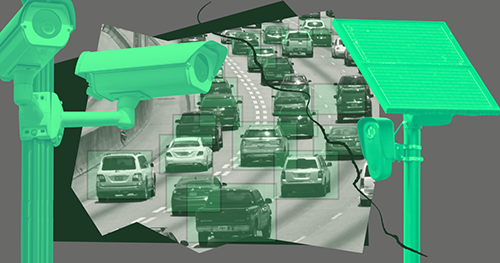
Automated license plate readers (ALPRs) have been around for decades and the ACLU of Northern California has been raising the alarm since at least 2013. But only in the last few years have ALPRs earned the reputation they deserve, as communities around the country demand their removal.
So what are ALPRs, why are they so harmful, why are they in the spotlight now and what can California laws do to curb their harmful effects?
What are ALPRs?
ALPRs are not normal traffic cameras. They are mass surveillance systems created by surveillance technology companies and marketed primarily at law enforcement. They are dragnet systems that record and track every car in their view, regardless of whether the car is connected to any suspected wrongdoing. Artificial intelligence (AI) algorithms then catalog the make, model, color, license plate number and even bumper stickers on every car, and often capture images of drivers and passengers.
All this personal information is collected into massive databases, where law enforcement retains it--sometimes even for multiple years--regardless of whether the information is connected to an ongoing investigation.
ALPR systems allow effortless sharing between law enforcement agencies, so information collected by one police department could end up with a police department across the country, or in the hands of federal government agencies like Immigration and Customs Enforcement (ICE).
How are ALPRs harmful?
ALPRs threaten our civil rights and liberties in numerous ways:
First, by collecting an unprecedented amount of personal information from every driver who passes by their camera lenses, regardless of any suspected wrongdoing, ALPRs restrict our ability to live freely. Simply knowing that our information is being collected has been shown to change behavior and stifle personal autonomy.
Second, by retaining our personal information in massive databases for excessive periods, sometimes as long as multiple years, ALPRs allow surveillance companies and law enforcement to gather intimate details about our private lives and use that information to track our movements, map who we associate with and predict where we may go in the future.
Third, by sharing that information with minimal guardrails, including across state lines and with federal agencies like ICE, ALPRs can deliver our personal information into the hands of hostile actors.
Fourth, there are few regulations limiting how law enforcement can access these databases and officers may be required to provide little justification for accessing the information. In some cases, law enforcement does not even bother to invent a reason--one officer simply typed "la la la" when asked to justify a database search. Without meaningful guardrails, ALPRs facilitate horrific abuses of power, including running searches on behalf of ICE in violation of state law, tracking people seeking reproductive care, and outright stalking romantic partners, exes, or even complete strangers.
Communities receive almost no benefit in exchange for these harms. ALPRs are inaccurate and do not keep communities safe.
ALPRs are shockingly unreliable, often misreading plates entirely, with recent reporting showing an error rate as high as 71%. This inaccuracy leads to mistaken arrests and innocent people being held at gunpoint. And despite claims by surveillance vendors and their law enforcement clients that ALPRs solve crimes, they do not improve safety or help police close more cases. Perhaps this is unsurprising, given that less than 1% of all plate scans are connected to any wrongdoing.
ALPRs are harmful enough as they are, but surveillance companies are actively seeking ways to make the technology even more harmful and more targeted at tracking individuals. Flock offers an AI-powered image recognition product called "FreeForm" that allows law enforcement to search for individuals based on their physical appearance. Flock's competitor Leonardo markets a product called "SignalTrace" which would add sensors to ALPR cameras capable of tracking all the electronics people carry with them, from their phones and smartwatches to the microchips in their pets. Leonardo then packages those signals into an "electronic fingerprint" that law enforcement can use to track individuals.
So why now?
Despite being around a long time, ALPRs are finally receiving the notoriety they deserve, with certain companies like Flock facing particular scrutiny. But make no mistake: Flock has many competitors, like Motorola, Azon, Genetec and Rekor, who all deserve the same scrutiny. These surveillance systems have proliferated over the years, with Flock alone operating cameras in over 6,000 communities, capturing over a billion images a month.
At the same time, the second Trump administration has crystallized the sometimes-abstract harm of privacy violations. Trump's brutal crackdown on immigrant communities outraged many, while reporting showed that ICE relies on ALPRs. This abuse helped connect driver privacy with the well-being of our communities and neighbors.
While ALPRs are a national problem, they are purchased and installed at the local level, so community-level activism can lead to actual change. Rather than marching on Washington, D.C., community members can petition their local governments.
How can California laws curb ALPR use and abuse?
California has built some of the nation's strongest driver privacy protections. One law in particular, SB 34, prohibits police from sharing ALPR information with the federal government and law enforcement outside of California. Individuals harmed by violations of the law can sue under the law's private right of action.
Unfortunately, many law enforcement agencies have been slow to comply, requiring litigation and advocacy by civil rights groups like ACLU NorCal and the Electronic Frontier Foundation (EFF), and prompting compliance instructions and an enforcement action from the California Attorney General. When enforced, SB 34 protects Californians from some of the harms caused by sharing ALPR information, but it does little to protect against rampant collection, retention, or misuse of ALPR information by California law enforcement agencies.
Constitutional protections can limit some of the other harms. As the U.S. Supreme Court held in Carpenter and recently reaffirmed in Chatrie, the Fourth Amendment protects location information reflecting people's physical movements, even movement in public spaces.
The California Constitution is even more protective of location privacy. Article I, Section 13 protects against unreasonable searches and seizures, while Article I, Section 1 provides an explicit right to privacy and was designed expressly to prevent "government and business interests from collecting and stockpiling unnecessary information about us and from misusing information gathered for one purpose in order to serve other purposes..."
In our ongoing lawsuit against San Jose, EFF and ACLU NorCal argue on behalf of Services, Immigrant Rights and Education Network and the Council on American-Islamic Relations - California that these California constitutional rights doubly protect against ALPR misuse by requiring law enforcement to obtain a warrant prior to conducting retrospective searches of ALPR databases.
ALPRs threaten our civil rights and liberties and do little to protect communities. California statutory and constitutional law can address some of those threats, but the laws must be enforced. Communities can also fight back outside of the courts and free themselves from the unblinking eye of mass dragnet surveillance systems by demanding that their policymakers break up with surveillance technology.
Submit your own column for publication to Diana Bosetti
For reprint rights or to order a copy of your photo:
Email
Jeremy_Ellis@dailyjournal.com
for prices.
Direct dial: 213-229-5424
Send a letter to the editor:
Email: letters@dailyjournal.com