


Judges and Judiciary
Sep. 2, 2026
The agentic referee
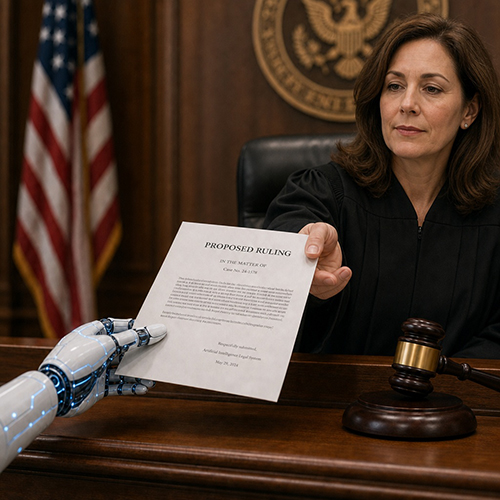
The "agentic referee" offers one way to explore adjudicative AI while preserving transparency, meaningful human oversight and ultimate judicial responsibility for every decision.



In four earlier articles in the Daily Journal, I explored what responsible use of AI by the courts might look like. As AI increases court filings and court staffing remains constant--or declines due to budgetary pressures--courts are under increasing pressure to turn to AI for operational, case management and adjudicative purposes.
I previously discussed the use of AI to support the judicial function in discrete tasks that tend to be repetitive and fact-bound, such as the review of default judgments and proposed class-action and PAGA settlements. (See Karin Schwartz, "Can AI reduce the work It creates?" (Daily Journal, Aug. 6, 2026); "Return to the cave: AI and the protection of absent parties" (Daily Journal, Aug. 10, 2026).)
Of the potential uses of AI, adjudicative uses present the most sensitive issues. Such uses implicate fundamental and long-settled premises about how cases are decided. By adjudicative AI, I mean AI that participates directly in the adjudicative process, under carefully defined conditions, with appropriate transparency, meaningful human oversight, and ultimate judicial responsibility for every decision. (See Karin Schwartz, "Beyond chatbots: Is there a role for adjudicative AI?" (Daily Journal, July 28, 2026).)
The potential uses of adjudicative AI fall along an agentic spectrum. Some, presumably the least controversial, are wholly subordinate to the judicial officer: for example, review of default judgments pursuant to a checklist.
In this article, I offer a proposal farther along that spectrum: the agentic referee. The notion may not be as far out as it initially sounds. We already have procedural analogs as well as a recent technological one. Earlier this year, the American Arbitration Association introduced an AI-enabled arbitration process in which AI analyzes the parties' submissions and prepares a draft award for review by a human arbitrator. (See https://www.adr.org/ai-tools-and-technology/) The development illustrates that a careful and bounded division of adjudicative labor between AI and a human decision-maker is no longer merely theoretical.
The agentic referee would bring a related concept into the courts, but with a different structure. With the parties' knowledge and consent, AI would propose the initial disposition of a defined dispute. The parties would then have the opportunity to challenge its conclusions, and a judge would independently decide the challenged issue. California's existing reference procedure provides a useful analog for such a process.
Consider a discovery motion.
In many California trial courts, parties may wait months for an ordinary motion hearing. In the civil direct-calendar department over which I presided until recently, the first available reservation date for a motion was over four months away. Judges can and do accommodate genuinely time-sensitive matters, but advancing one motion necessarily consumes judicial capacity somewhere else.
What if the court could offer another option?
With full disclosure and the consent of all parties, the parties could stipulate to submit a discovery dispute to an appropriately designed and vetted legal AI system for an initial proposed disposition.
The familiar reference procedures of Code of Civil Procedure sections 638 and 639 offer a useful model, although I am not suggesting that section 639 itself authorizes an AI referee. Rather, the parties would stipulate to the process and agree on its terms.
The agentic referee would receive the operative complaint and the same motion record the judge ordinarily would: the motion, separate statement, declarations and exhibits; the opposition and accompanying materials; and the reply. Its factual analysis would be confined to that record, and its legal analysis to appropriate, verifiable legal sources.
It could then work through the discovery requests, identify the objections and arguments, apply the governing law, and produce a reasoned proposed disposition.
Both sides would receive exactly what the AI produced. Both would know in advance how the proposed disposition was generated. Either could object to any portion of it.
If either side made an objection, the judge would decide the challenged issues, exercising his or her independent judgment.
That changes the work arriving at the judge's desk. Instead of confronting dozens--or sometimes hundreds--of individual discovery disputes for the first time, the judge might receive objections to only a handful of proposed rulings. And those rulings already would have been scrutinized by parties with every incentive to identify errors.
The resulting judicial decision might therefore be not only faster, but better vetted.
This would not be appropriate for everything. Certain decisions--terminating sanctions and issue sanctions are obvious examples--should remain with a human judge. Nor does the proposal assume that every existing legal AI product is capable of serving as an agentic referee. The relevant technology would have to be designed and vetted for the task. Nor is the model designed for every litigant. It presupposes represented parties of roughly comparable capacity, each able to scrutinize the proposed disposition and object; it is not a substitute for judicial attention where one side is self-represented or materially outmatched.
Perfection cannot be the standard. An AI reviewing a massive discovery record may miss something, but so may a human judge. A transparent process that allows both adversaries to identify errors, followed by genuine judicial review when requested, is designed around the reality that mistakes can occur.
The ethical question
California has already begun addressing judicial use of generative AI. California Rules of Court, rule 10.430, and Standard 10.80 of the Standards of Judicial Administration establish a framework that emphasizes confidentiality, accuracy, freedom from unlawful bias, and responsible judicial use.
Much of that framework fits comfortably with an agentic referee.
The system should be closed and appropriate for adjudicative materials. It should not independently investigate facts outside the record. Its legal research should be limited to appropriate sources. The parties should know AI is being used and how. And the judge must remain competent to independently decide any issue ultimately presented for judicial determination.
One requirement presents a more interesting question.
Rule 10.430(d)(3) requires court policies to require court staff and judicial officers who create or use generative-AI material to take "reasonable steps" to verify its accuracy and correct erroneous or hallucinated output in material used. Standard 10.80(b)(3) contains similar guidance for judicial officers acting within their adjudicative role.
A transparent adversarial process arguably supplies those reasonable steps. Both parties receive the AI output. Both can identify errors. And any challenged determination receives independent judicial review. Those reasonable steps also operate at the level of system design: institutional vetting and validation of the tool before deployment, disclosed adversarial review, and de novo judicial determination of objections together supply the required diligence, rather than any single after-the-fact check.
But there is tension. If the rule is understood to require the judge to personally review and verify the entire AI-generated disposition before it is provided to the parties, much of the benefit disappears. The judge effectively must decide the motion before the agentic referee can do its work.
Perhaps "reasonable steps" is flexible enough to encompass a disclosed, consensual process of adversarial review followed by independent judicial determination of objections. If not, this may be an area in which rules written for one model of judicial AI use eventually need to be reconsidered as new models emerge.
The Code of Judicial Ethics raises a related issue. Canon 3B(7)(a) provides that, while a judge may consult with others (such as other judicial officers) in certain circumstances, the judge may not "abrogate the responsibility personally to decide the matter." Nonetheless, California already permits parties to stipulate to adjudication by human referees. Indeed, under Code of Civil Procedure section 638, parties can agree to a reference that goes considerably further than the process proposed here.
Under the agentic referee model, the right to human judicial review would be preserved. When a party objects and presents an issue to the judge, the judge must actually decide it. The AI cannot substitute for the independent judgment the canon requires. Judges already receive proposed dispositions from research attorneys and adopt or modify them after independent review; the agentic referee differs mainly in that the parties see its work and can contest it, making the process more transparent than the bench memorandum it resembles.
The ethical analysis also may depend on how the process is structured. A court-operated agentic referee and a third-party AI process selected by stipulating parties may present different questions. Those details would have to be worked through in designing an actual pilot.
Disclosure is not merely a safeguard here; it is one of the strengths of the model.
Much of the concern about judicial AI understandably focuses on what might happen if judges quietly rely on AI without litigants knowing what role it played. The agentic referee reverses that paradigm. The parties know what the AI is doing. They agree to let it do it. They see its work. They can challenge it. And a human judge remains available to decide the issues they continue to dispute.
That seems a promising way to experiment.
Living with the tension
There is, of course, a much larger conversation about artificial intelligence underway. The concerns include AI's environmental demands, the consequences of increasingly pervasive reliance on AI, the possibility of unexpected behavior, and the uses to which powerful technology may be put by human actors. We do not yet know where all of this leads.
But AI is also here. Ignoring it will not make it disappear. It has the potential to improve access to information, reduce burdensome work and help institutions--including courts--do some things better.
Those propositions can coexist.
Socratic aporia--the state of productive perplexity--recognizes that inquiry sometimes leaves us confronting uncertainty rather than a neat answer. Perhaps there is something particularly human in our capacity not merely to recognize that complexity, but to live--and potentially thrive--within it.
We can recognize the risks of artificial intelligence while remaining curious about its possibilities. Uncertainty need not produce paralysis.
The agentic referee is one small way to ask what thoughtful movement forward might look like.
Author's Note: AI tools were used in the research and development of this article. The ideas are my own. All authorities have been checked by the author, and I accept full responsibility for every statement and conclusion expressed here.
Submit your own column for publication to Diana Bosetti
For reprint rights or to order a copy of your photo:
Email
Jeremy_Ellis@dailyjournal.com
for prices.
Direct dial: 213-229-5424
Send a letter to the editor:
Email: letters@dailyjournal.com