


Civil Procedure
Sep. 24, 2026
Fixing our broken civil discovery culture: Objectionable objections
The author argues that routine, meritless objections to written discovery delay litigation, increase costs and burden courts, and calls on lawyers and judges to curb the practice through substantive responses and greater use of sanctions.


Stanley Mosk Courthouse
Lawrence P. Riff
Supervising Judge
Los Angeles County Superior Court
General Civil, UDs
University of Oregon School of Law, 1982
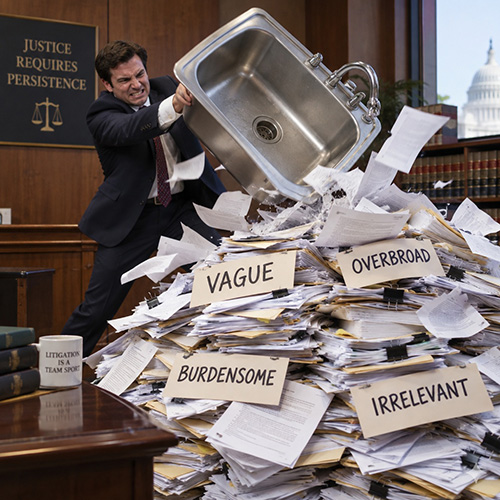
Today's topic is lazy, rote, unthinking discovery objections made to written discovery--which is to say, virtually all such discovery objections. With almost no exception, those objections have no legal merit whatsoever, at least when interposed to non-abusive written discovery requests. They are just paragraphs of wasted printer ink, never to be seriously considered by any lawyer, client or judge.
One could argue that since nobody pays any attention to such objections, they are no big deal. Not so. Discovery objection abuse seriously retards forward progress in litigation, often for months, for no good reason, and at great public and private expense. The objections are made instead of genuine substantive responses, resulting in fruitless "meet and confers" (in which counsel neither meet nor confer), and lard up court calendars with motion practice that should never see the light of day.
In fact, discovery objection abuse represents a principal flaw in our broken civil discovery culture. No sentient lawyer, client or judge would disagree. So why is it so prevalent and persistent? Because our profession's leadership (bench and bar) has permitted successive generations of upcoming lawyers to sleepwalk into the bad habits of their elders. Seasoned lawyers--those who understand the relationship between sound discovery practice and actually trying a case--cringe when forced to focus on the swarm of meritless objections interposed by their more junior office mates. And institutional clients, too, should be chagrined. Why are they paying a lawyer hundreds of dollars per hour to make bad objections? Do they not realize how badly it reflects on them?
Yet there is no real sanction, culturally or financially, against this species of litigation abuse. Many lawyers are beaten down and think seeking change is hopeless and quixotic. Too ingrained in the cultural DNA, they say. Others rally and say, yes, let's change the culture--you go first. But we need not put up with this. Spitting on the sidewalk, drinking and driving, smoking in restaurants and littering were once widely accepted social behaviors. Now they are the stuff of social stigma. Once called out and shamed, the behaviors receded. Let us call out written discovery objection abuse and chant "shame!"
With that rant behind me, I now acknowledge that there is a legitimate role for objections in written discovery practice in a discovery culture characterized by overbroad, ill-defined and obviously unduly burdensome discovery requests. Still, as a first principle, litigants (clients, I'm talking to you!) must accept that propounded discovery imposes a good-faith duty upon the recipient to respond substantively. It may seem galling, unpleasant, and difficult, but, as your parents once said, eat your peas and go upstairs and do your homework. It is a responsibility and seeking to avoid it is, well, irresponsible (and contrary to law).
A legitimate discovery objection has two parts. First, it
identifies a specific legal limitation on an otherwise applicable discovery
obligation. It is a mechanism for saying this particular request exceeds the
legitimate scope of discovery for this particular reason. That reason might be
its overbreadth, its incomprehensibility, the disproportionate burden
associated with the production as compared with the importance of that
information, or that it calls for material that the responder has a legal right
not to provide because of, say, privilege or privacy. Second, the responder
should produce responsive information or documents in response to the
non-objectionable part of the request. A classic example: "Responding party
objects that the request is overbroad and imposes an undue burden in that
the it is whollyin that it is wholly unlimited as to time. However,
responding party will produce responsive documents from January 1, 2020 to
December 31, 2025." See? How hard was that? Now let the propounding party
explain why that response is insufficient.
So, (1) objection particularity followed by (2) a responder-redefined substantive response. That may not be the end of the discussion on the discovery item but it is a great head start. This is not what we see in practice. Too often, following a barrage of non-particularized objections, there is no substantive response--the unstated premise being, "tag you're it; I dare you to do something about it." It is obvious that the objections are interposed to create procedural barriers to discovery, to eat up available time before trial, to try to reserve every conceivable (and some inconceivable) defenses, to change the litigation to a war of attribution, and generally to shift to the propounding party the burden of obtaining information that the responding party is otherwise obligated to provide. The unstated goal of interposing most discovery objections is to delay, complicate, and obfuscate. It is to frustrate the truth-finding function of litigation. Shame!
Here are five of the worst written discovery objection abuses.
First, the "kitchen sink." Every request gets the same laundry list: "vague, ambiguous, overbroad, burdensome, oppressive, irrelevant, immaterial, assumes facts, calls for speculation, attorney-client privilege, work product, privacy, and all other applicable objections." One might make it simpler by objecting "on every possible basis under the Code of Civil Procedure, the Evidence Code, the California Rules of Court and the common law of all English-speaking countries." By purporting to include everything, the objector has said nothing. This profound credibility killer is "the lawyer who cried 'objection'" (cf., the boy who cried 'wolf') and is met universally with an eye-roll, disregard and general disdain. Lawyers who commit this sin should have their "copy and paste" feature permanently disabled.
A pernicious species of the "kitchen sink" is "general objections." Situated at the front of the response, and purportedly incorporated by reference into all responses, these aggregations of words can go on for pages. There are at least two problems, starting with the fact they are neither authorized nor lawful. Any objection must be particularized and relate specifically to the propounded discovery item. See, for example, CCP 2030.210 which requires the responding party to respond separately to each interrogatory, including by making an objection to the particular interrogatory. The same rule of particularity applies to requests for production and requests for admission. Because objections must be particularized, the very invocation of the adjective "general" explains how they are wrong.
The second and practical problem is that nobody could possibly have any idea what the objector is actually asserting. A list of general objections is a statement of possible objections that the responder claims the right to assert against everything. On a personal note, in 44 years of this business, lawyer and judge, I have never seen a bona fide discovery dispute turn on the assertion of a general objection. If anyone out there has an example, please let me know so that I may notify the folks at Ripley's. This reform is pretty easy: no more general objections, period.
Second, objecting but not further responding when clearly responsive information exists. So, "Objection: overbroad, burdensome and irrelevant"--and then . . . crickets. Again, "tag you're it; I dare you to do something about it." I say this is per se sanctionable discovery abuse irrespective of the ultimate meet and confer outcome. Second time I'll say it: where possible (which is almost always), make the objection and then provide a response to the part of the request that is not objectionable or redefine the request to eliminate the objectionable portions. Here is an example to a poorly drafted discovery item, "Responding party objects that the [RFP] [interrogatory] [RFA] is vague and incomprehensible. But without waiving these objections, and based upon our understanding of the gist of the [RFP] [interrogatory] [RFA], we respond...." This response is the starting point of a thoughtful discussion and shows the judge, eventually, that you were not playing games.
But Judge Riff (I hear you say), you are making me do their work! It's not my job to help them do discovery against me! To that I say: first, study your classical history and the story of King Pyrrhus of Greece (from whom we derive the expression a pyrrhic victory). Second, ask your client: "I can spend $35,000 litigating this discovery item where at the end we will have to produce information we know that they really are after and to which they are entitled, or I can just produce it now and likely obviate a discovery battle. What would you like me to do?" And clients, you should make sure your lawyers are giving you this option. A similar cost-benefit analysis applies to contingency fee plaintiffs' work--what is the opportunity cost expended in a pyrrhic discovery battle?
Third, the objection plus a non-answer answer. We are no longer talking about crickets after the objection; we are talking about non-responsive pablum. So: "Identify persons who have information about the subject car accident. Objection: the terms "persons" and "accident" are vague and undefined. Without waiving these objections, responding party states that there were people who saw the collision." There is so much obviously wrong with these objections and response, but I won't insult any readers by explaining further. Yet under our current culture, it may well take five months for the responding party to actually answer this simple interrogatory.
Fourth, the muddled, vague objection. A response made "without waiving and in light of the foregoing objections" is indeed a muddle. Does the response mean that the responding party has agreed to provide all the requested information or only a subset which it decides to provide, silently holding back the rest based upon the objections? This is also a species of "tag, you're it," shifting to the propounding party the risk of the unclear response. The answer to this is simple enough: the responder should be required to state whether they are or are not holding back anything. Example: "Notwithstanding the objections, the Responding Party states that it is not withholding any [responsive documents] [information] based on those objections." Or, "Responding Party states that its response does not include all [documents] [information] apparently called for by this objectionable discovery item." The first response means that the propounding party probably won't bother to follow up with a meet and confer. The second response is a big head start on that meet and confer, starting with the questions, "what did you hold back and why?"
Fifth, pretending you can't understand the question. Example: "Identify each person who was present when the contract between Plaintiff and Defendant was signed on March 15, 2026. Response: Objection. This interrogatory is vague and ambiguous as to the terms 'present' and 'signed.' Without waiving the foregoing objection, Responding Party identifies John Smith, Mary Jones, and Robert Brown as persons present at the signing of the contract." This is an example of the object-no-matter-what school of discovery. It makes the responder appear either insipid or obstructionist--probably both. Counsel went to a four-year university, attended law school, and passed the California bar, and doesn't know what "signed" means? Does her client know that? What would be so wrong with just answering the straightforward question without any meritless objections?
A last thought for judicial officers. Are we doing our part to stop this abuse? The Legislature has given us a powerful tool and a mandate: "If a monetary sanction is authorized by any provision of this title, the court shall impose that sanction unless it finds that the one subject to the sanction acted with substantial justification or that other circumstances make the imposition of the sanction unjust." CCP 2030.030(a) (emphasis supplied). There is no substantial justification for the widespread abuses identified in this article. Moreover, lawyers engaging in such abuse are likely violating Business and Professions Code section 6068 (to support the laws of California) and the Rules of Professional Conduct, Rule 3.1 (a lawyer shall not assert a position in litigation without probable cause). Yes, sanctioning lawyers is distasteful and unpleasant. But a firmer hand and more predictability of outcome has its place in changing cultures. Drinking and driving did not lessen based on public service messages alone.
Submit your own column for publication to Diana Bosetti
For reprint rights or to order a copy of your photo:
Email
Jeremy_Ellis@dailyjournal.com
for prices.
Direct dial: 213-229-5424
Send a letter to the editor:
Email: letters@dailyjournal.com