


Tax
Sep. 28, 2026
The billionaire tax is good policy and good law
Proposition 40 would impose a one-time 5% tax on California billionaires' wealth to help offset healthcare cuts. Its proponents argue that the measure is both economically sound and legally defensible against challenges raised by opponents.



David Gamage
Law School Foundation Distinguished Professor of Tax Law and Policy
University of Missouri School of Law

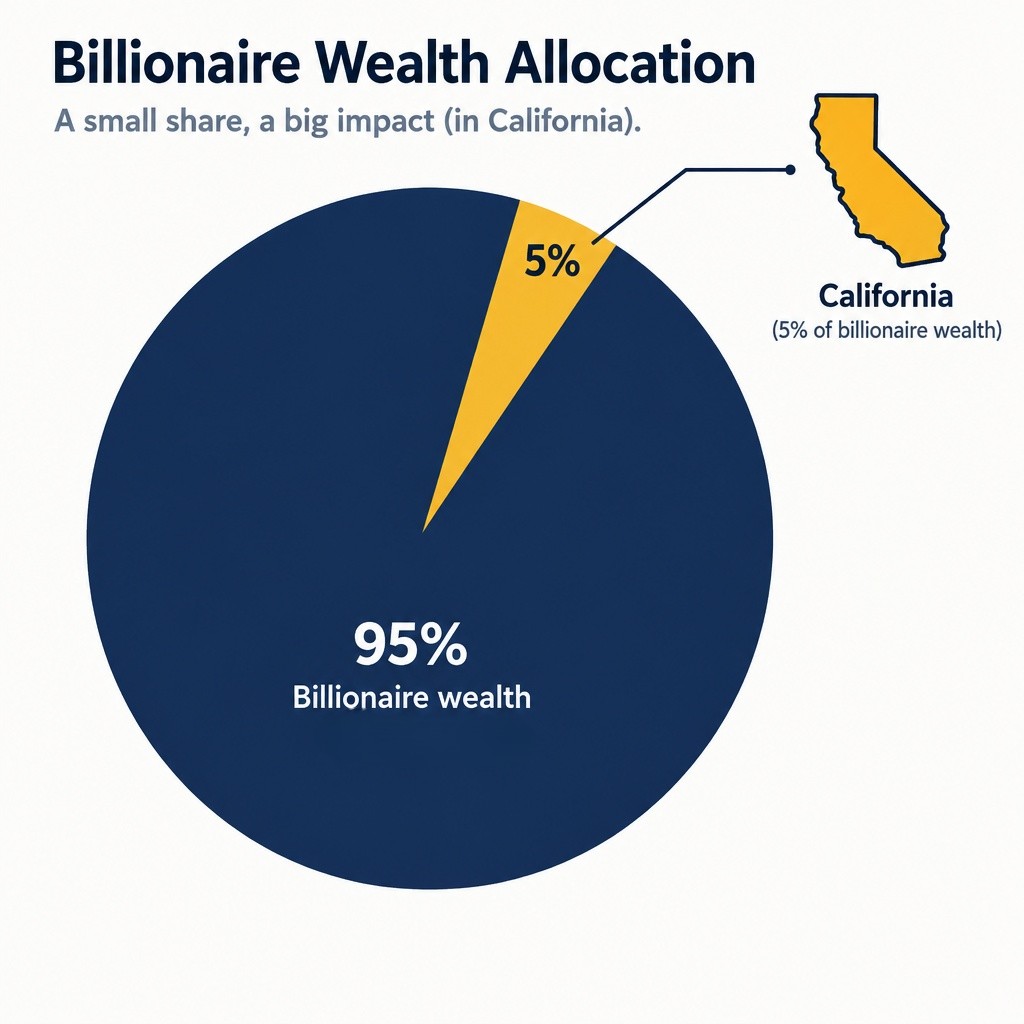
Proposition 40 would impose a one-time 5% tax on billionaire wealth. The tax can be paid in five installments (1% and interest). There is also a deferral mechanism for liquidity-constrained taxpayers. Most of the assets of billionaires are public and hence easily valued. Most of their remaining assets are in large private companies that are also readily valued because they are often valued for purposes of funding. As a backup, there is a default formula modeled on one that has been used in Switzerland for a century. (General explainer with FAQs here).
Most of the revenue raised from the tax will be used to triage the cruel and sweeping healthcare cuts that were passed in July 2025 and scheduled to go into effect next year.
As a matter of tax policy, that billionaires do not pay much in income (or property) taxes relative to their ability to pay should be intuitive to lawyers. Say a lawyer works on a valuable IPO and receives a large bonus--that bonus is subject to California's substantial personal income tax rates. The billionaire created by the IPO pays nothing on their vast increase in wealth. And, if they wish to purchase an estate with their newfound riches, then all the billionaire has to do is borrow, and borrowing does not trigger the income tax. So still no taxes. This is the loophole created by the realization rule.
An annual 1% tax is also likely familiar to many readers; it is what Californians with a home pay on their real property wealth, which is likely to be most of their wealth. Prop. 40 asks billionaires to pay basically the same amount on their intangible wealth and only for five years.
To be sure, there have been many objections raised against Prop. 40. At the policy level, these claims amount to fearmongering about billionaires leaving. What matters to the state are its economic aggregations and, based on record in-flows of capital, these do not seem to be much impacted by mean tweets from a handful of billionaires who have already made their fortunes and do not pay much in taxes.
There have also been many legal objections. Experienced lawyers know that the side with the greater volume of legal arguments is often the weaker one. This is because the prolific side has no one good argument, just a lot of weak spaghetti arguments to throw at the wall, as is the case here. We have tried to address each of these arguments at least once in some depth and so will content ourselves here with a few examples and some links to further responses.
It is objected that Prop. 40 cannot apply to residents of California on Jan. 1, 2026. Yet the test under the Due Process Clause is rational basis and the Court has, accordingly, blessed statutes that go into the previous year. Or it is argued that a billionaire who spends New Year's out of state defeats the residence rule of Prop. 40 because the testing date was Jan. 1, 2026. Yet Prop. 40's residence rule is based on reasonable and longstanding California residence law. A resident is presumed to stay a resident and a temporary absence and a loud tweet announcing that one is leaving does not defeat the presumption. Finally, it is sometimes argued that Prop. 40 permits nefarious amendments, but it does not. Without an option for narrow changes, the California Constitution permits no changes by the Legislature to statutes added by ballot measure. Permitting such changes is very common and has been adjudicated carefully by the courts. (See our section-by-section explainer here).
And on it goes. One way to know that the basic policy and legal structure of Prop. 40 is sound is to observe the noise being generated by its opponents. Why all the fuss if the tax is bound to fail as a matter of law and policy? Why put two deceptive measures (Props. 41 and 42) on the ballot to defeat Prop. 40 if one really believed the arguments against Prop. 40? We have provided links to the ballot measure and our explanatory materials; we urge readers to read these materials for themselves.
Gamage and Shanske were both among the drafters of Proposition 40 and are coordinating with the campaign to pass it; this Article and all of their other related academic writings are their expert and scholarly views.
Submit your own column for publication to Diana Bosetti
For reprint rights or to order a copy of your photo:
Email
Jeremy_Ellis@dailyjournal.com
for prices.
Direct dial: 213-229-5424
Send a letter to the editor:
Email: letters@dailyjournal.com