


Ethics/Professional Responsibility
Apr. 13, 2026
Don't let others chip away at privilege
In today's world, lawyers face commonplace situations that can easily lead to inadvertent--or reckless--disclosure of privileged information, demanding constant vigilance to protect the attorney-client relationship.


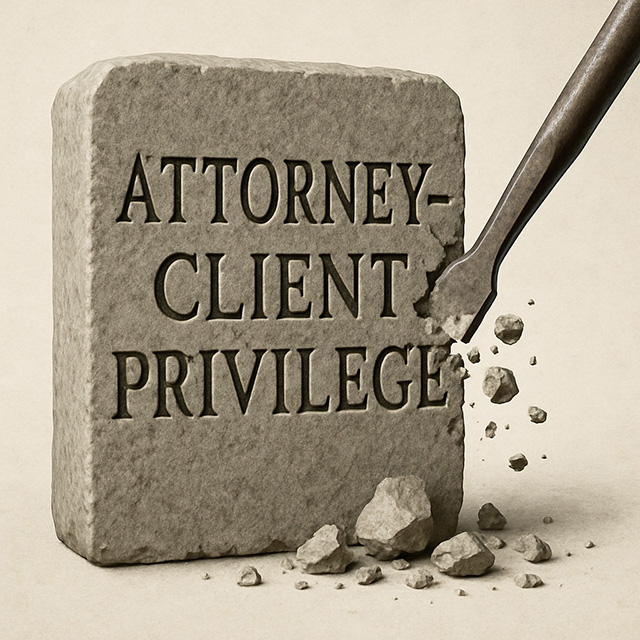
The sanctity of the attorney-client relationship is a bedrock legal principle. This protection is long-standing but is rooted in the premise that society wants to encourage clients and lawyers to speak freely and openly with each other without those communications becoming public knowledge. Clients benefit from being advised on the law by their counselors, and lawyers are benefitted by having fulsome and open discussions with clients.
Clients typically have the power to waive the attorney-client privilege or protections for confidential information. A client considering a waiver of these protections will often be advised by a lawyer as to the risks and benefits of such an approach, and whether those benefits outweigh the risks. Lawyers have an obligation to maintain confidences and secrets--but what happens if the lawyers do not do enough to protect the privilege?
If a lawyer fails to take proper steps to protect attorney-client confidential information, it can put the entire relationship at risk. And a lawyer who divulges privileged information through carelessness or a failure to safeguard may face a claim from a client.
In today's world, there can be several common situations that, if not handled carefully, could erode the attorney-client relationship or chip away at the shared privilege. Here are some situations where lawyers must take care not to inadvertently (or recklessly) disclose privileged information.
Rideshares, elevators and airplanes
When on travel or in public places, lawyers may let their guard down in a way that puts privilege at risk. For example, a lawyer sitting at a restaurant having a conversation on their phone about a privileged matter runs the risk of being overheard by others. There have been news stories in recent years where lawyers at a restaurant who were discussing highly confidential information were overheard by reporters, who then reported on the information.
Other situations--such as traveling on a plane or riding in a cab or rideshare--can also pose risk. Many lawyers try to maximize travel time by doing client work, but where a person two rows behind on an airplane can read the documents on the lawyer's computer, that can create risk of disclosure of secrets.
To help minimize the risk of a privileged conversation being overheard (and thus creating risk for the entire relationship), lawyers may consider ending calls until they can be held in a more secure, private area or can be careful not to disclose confidential information while on the phone that, if overheard, could make public the identity of the client or other confidential information. Lawyers traveling on planes can use privacy screens or other technology to help ensure that the documents on their screens are for their eyes only.
When someone else pays the bills
It is a common situation for a third party to pay someone's legal fees. This could be a company paying legal fees on behalf of an employee, a parent paying legal fees on behalf of a child, or even an insurance company paying fees on behalf of an insured. For entities like insurance companies, who are often involved in the strategy of the defense by the terms of the policy, sharing confidential information typically does not risk the protections of the attorney-client relationship shared by the insured and the lawyer. Often, the insurer is understood to also share in that relationship. But in other situations, lawyers may have to take precautions to ensure that they have not eroded the protections of the attorney-client relationship by improperly sharing information with non-clients.
Rule 1.8.6 of the California Rules of Professional Conduct provides that lawyers may accept compensation from someone other than the client when certain circumstances are met: (1) there is no interference with the lawyer's independent professional judgment or with the lawyer-client relationship; (2) confidential and privileged information remains protected; and (3) the lawyer obtains the client's informed written consent (or confirms that such written consent is not required under the rules).
The comments to the rule confirm that the lawyer's responsibilities are owed "only to the client except where the lawyer also represents the payor in the same matter." The payor may be aligned with the client as a matter of law, which could support the application of a common legal interest privilege. But in circumstances where the payor does not otherwise share a legal interest with the client, sharing privileged information with the payor could create a risk of waiver.
Social media and online security
Proper cybersecurity is a must for any law practice. Even the most exacting practice can experience a data breach, so adopting sufficient protection and response protocols can help prevent a breach (or stop the bleeding to protect client files in the event of a cyber attack). Enacting appropriate protections around a lawyer's online files and materials help ensure that privilege is protected--and can be evidence to rebut any allegations that a data breach resulted from the lawyer's negligence or that the lawyer's failure to protect client materials should operate as a waiver.
Another way that a lawyer can create risk for the client's privilege stems from social media posting. Some states have strict rules about what a lawyer can post online about client matters. Even matters that have been reported on publicly in the media or on dockets may still not be appropriate for a social media post. Many lawyers attempt to camouflage posts about sensitive client matters, using vague terms or non-specific descriptors to try to protect the confidentiality of the matter. But if a lawyer's posts about a client matter are specific enough to reveal privileged information about the matter, the lawyer could be putting the privilege at risk.
By being aware of these risks that can negatively impact the attorney-client relationship, lawyers can do their part to maintain and protect the privilege.
Submit your own column for publication to Diana Bosetti
For reprint rights or to order a copy of your photo:
Email
Jeremy_Ellis@dailyjournal.com
for prices.
Direct dial: 213-229-5424
Send a letter to the editor:
Email: letters@dailyjournal.com