


Apr. 30, 2026
Uber/Lyft are liable for the drivers they put on the road
Uber has spent five years arguing Proposition 22 rewrote California tort law; a recent arbitration award confirms it did not--Section 5354 still imputes driver negligence to the permit holder, regardless of classification.



Arash Homampour
Sole Shareholder
The Homampour Law Firm PC
15303 Ventura Blvd.
Sherman Oaks , CA 91403
Phone: (323) 658-8077
Fax: (323) 658-8477
Email: arash@homampour.com
Southwestern Univ SOL; Los Angeles CA
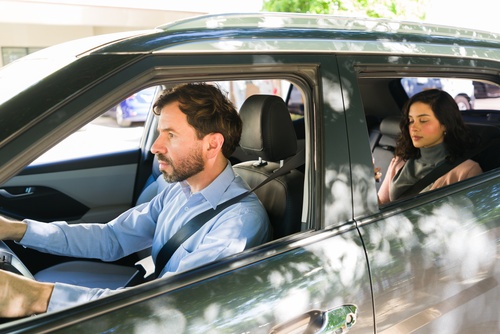
On March 31, 2026, an arbitrator issued a final award against Uber Technologies, Inc. in Rutkovitz v. Uber Technologies, Inc., AAA Case No. 01-24-0004-5195. An Uber passenger was injured when her Uber driver lost control on a rain-slicked off-ramp and struck a guardrail. While the driver's negligence was contested, the main dispute was whether Uber, the company that dispatched him under its CPUC permit, could be held liable, or whether Proposition 22 had insulated Uber from such liability. The arbitrator did not find Uber liable on an employee-classification theory. He did not need to. He applied Public Utilities Code section 5354, which provides that the act of any person offering authorized service with the permit holder's approval is the act of the permit holder itself. As the arbitrator put it: "The imputation under Section 5354 applies regardless of employment classification. (Proposition 22's independent contractor classification is irrelevant here.)"
Uber has spent the past five years arguing the opposite in California courtrooms: that Proposition 22 silently rewrote tort law and immunized transportation network companies (TNCs) from any responsibility for driver conduct. That argument is wrong as a matter of text, structure and history.
A history Uber would prefer to forget
Before Uber argued it owes no duty to anyone its drivers injure, it argued it owed no duty to follow California transportation law at all. (Goncharov v. Uber Technologies, Inc. (2018) 19 Cal.App.5th 1157.) Uber began operating in San Francisco without any CPUC license. After cease-and-desist orders, Uber settled, and the CPUC issued Decision 13-09-045 in 2013, creating the TNC category and requiring TNCs to obtain CPUC operating authority. The CPUC declared that "Uber by its name alone is selling a type of car service" and "should also be held responsible if the driver is negligent." Decision 14-04-022 found that, while TNC drivers are not employees, "they are clearly still agents connected with the firm." Decision 14-11-043 added safety obligations.
Uber's 2019 Class P TNC permit (TCP0038150-P) obligated it to "comply with all Commission orders, decisions, rules, directions, and requirements governing the operations of said Carrier, including Decisions 13-09-045, 14-04-022 and 14-11-043." Current CPUC records continue to list Uber and Lyft as TNC permit holders under TCP 38150 and TCP 32513, respectively. Uber chose to take that permit. Having taken it, Uber acquired both the privilege of operating on the public highways and the responsibilities the CPUC attached to that privilege, including responsibility for driver negligence under Section 5354 and the agency relationship the CPUC established.
Bus. & Prof. Section 7451 does not mean what Uber says it means
Business and Professions Code Section 7451 provides that, "notwithstanding any other provision of law," "an app-based driver is an independent contractor and not an employee or agent with respect to the app-based driver's relationship with a network company" if certain conditions are met. Uber argues this applies "for all purposes," but those words are not in the statute. The reclassification operates within a defined relationship, not at large. If Uber's reading were correct, the limiting clause would be surplusage. (Tuolumne Jobs & Small Bus. Alliance v. Superior Ct. (2014) 59 Cal.4th 1029, 1039.)
The contrast with parallel statutes is instructive. Florida (F.S.A. § 451.02) and Arizona (A.R.S. § 23-1603) classify app-based drivers as independent contractors "for all purposes under state and local laws." Proposition 22's drafters knew how to write those words. They did not. In Koussa v. Attorney General (2022) 489 Mass. 823, the Massachusetts Supreme Judicial Court struck virtually identical ballot language for violating that state's related-subject rule, where the operative phrase included the words "for all purposes." Reading those words back into California's statute would create a serious constitutional-avoidance problem under California's single-subject rule. (Cal. Const., art. II, § 8, subd. (d).) The Court of Appeal in Castellanos v. State of California (2023) 89 Cal.App.5th 131 described Proposition 22's overarching subject as the regulation of relationships between app-based drivers and network companies. Tort liability to injured third parties is not part of that subject.
Proposition 22 did not amend the Public Utilities Code, Civil Code section 2100, Section 5354, or Section 5433. The Attorney General's Official Title and Summary described it as a measure that "Exempts App-Based Transportation And Delivery Companies From Providing Employee Benefits To Certain Drivers." Nothing in the ballot pamphlet mentioned tort liability, common-carrier duties or the rights of injured third parties. Courts may consider only "materials that were before the voters." (Robert L. v. Superior Ct. (2003) 30 Cal.4th 894, 904 to 905.)
There is also a judicial-estoppel problem. In the Castellanos appellate proceedings, the Proposition 22 proponents (the same Uber and Lyft executives who drafted the initiative) defended it against a single-subject challenge by representing that it had a "single common purpose" of "comprehensively reforming the labor relationship between" TNCs and drivers. They prevailed on that representation. They cannot now argue Proposition 22 reaches further. (Victrola 89 LLC v. Jaman Props. 8 LLC (2020) 46 Cal.App.5th 337, 358.)
Theories of TNC liability that survive Proposition 22
Even on the most generous reading of Section 7451, several independent theories of liability remain available to injured plaintiffs. Each rests on a duty owed by the TNC itself or imposed by a separate statutory framework that Proposition 22 did not amend, repeal or even mention.
Public Utilities Code Section 5354. Section 5354 provides that the act, omission or failure of "any officer, agent, or employee, or person offering to afford the authorized service with the approval or consent of the permit or certificate holder, is the act, omission, or failure of the permit or certificate holder." The statute turns on permit status, not employment classification. Uber and Lyft hold the permits; their drivers do not. Drivers operate under the TNC's permit, with the TNC's approval, dispatched by the TNC's algorithm. Proposition 22 did not reference the Public Utilities Code, much less repeal it, and the presumption against implied repeal requires the two acts to be "irreconcilable." (Stop Youth Addiction, Inc. v. Lucky Stores, Inc. (1998) 17 Cal.4th 553, 570.) They are not.
Common-carrier liability. Civil Code section 2100 imposes a duty of "utmost care and diligence" on common carriers of persons. The CPUC has classified TNCs as a subcategory of common carrier since Decision 13-09-045. Proposition 22 says nothing about Section 2100.
Nondelegable duty. In Eli v. Murphy (1952) 39 Cal.2d 598, 600, the California Supreme Court held that a CPUC-licensed highway common carrier cannot delegate safety duties to an independent contractor: "[T]he effectiveness of safety regulations is necessarily impaired if a carrier conducts its business by engaging independent contractors over whom it exercises no control."
Direct negligence. A hirer is liable when it knew or should have known that a contractor was unfit and that unfitness created a risk of harm. (Noble v. Sears, Roebuck & Co. (1973) 33 Cal.App.3d 654, 660 to 663.) TNCs design their own driver-screening, control their background-check vendors, set their retention thresholds and decide whether to remove drivers about whom they have received complaints. None of this depends on whether a driver is technically an "employee" or "agent."
Negligent undertaking. When a defendant voluntarily assumes safety responsibilities, it must perform them with reasonable care. (Artiglio v. Corning Inc. (1998) 18 Cal.4th 604.) TNC commitments to review reports of unsafe driving and remove unsafe drivers can support a negligent-undertaking claim where the company assumed a safety function, performed it negligently, and either increased risk or induced reliance.
Ostensible agency. Section 7451's reclassification operates "with respect to the app-based driver's relationship with a network company," not as to relationships with passengers and the public. Ostensible agency, governed by Civil Code sections 2300 and 2317, asks whether the principal's conduct caused a third party reasonably to believe the actor was its agent. TNCs spend billions on branding designed to produce exactly that belief. (See Secci v. United Independent Taxi Drivers, Inc. (2017) 8 Cal.App.5th 846, 859 ["agency and independent contractorship are not necessarily mutually exclusive legal categories"].)
Secci regulated-hirer exception. A hirer subject to government safety regulation cannot escape vicarious liability by labeling its workers independent contractors. The CPUC has expressly declared TNC drivers to be "agents connected with the firm." (Decision 14-04-022.)
Negligent entrustment and concealment. Where a TNC supplied, leased, financed or controlled access to a vehicle, negligent-entrustment liability turns on what the company knew about the driver's fitness. Concealment claims are available where the elements (a duty to disclose, a material concealed fact, intent, justifiable reliance and damages) can be proved.
The insurance mandate is a floor, not a ceiling
Public Utilities Code section 5433, subdivision (f) provides: "This article does not limit the liability of a transportation network company arising out of an automobile accident involving a participating driver in any action for damages against a transportation network company for an amount above the required insurance coverage." The Legislature would not have preserved liability above the $1 million floor if no such liability existed. The savings clause confirms what Section 5354 imputes: the insurance requirement is a minimum, not a maximum, of TNC accountability. Section 2106 lets an injured party enforce the Public Utilities Code directly.
Uber's three-audience strategy
Uber has told three different audiences three different stories about what it is and is counting on the courts not to notice. Before the CPUC, Uber obtained operating authority by accepting classification as a charter-party carrier and submitting to the regulatory framework that came with it, including Section 5354's imputation rule. Before voters, Uber's supporters described Proposition 22 as a measure to protect driver independence and provide new benefits, not as a repeal of the carrier-liability framework the CPUC had imposed. And now, in court, Uber argues that the very initiative voters understood as a labor-and-benefits measure silently eliminated the tort accountability that the CPUC required as a condition of letting Uber operate. Courts should not sanction an interpretation that allows Uber to accept the privileges of its CPUC permit while disclaiming the obligations that accompany it.
The asymmetry problem
Most cases against Uber and Lyft are diverted into private arbitration through mandatory click-through terms, often filed by plaintiffs without the resources to brief these issues fully. In that asymmetric environment, Uber has won on its expansive reading of Proposition 22 by default, with no published opinions to police it. The Rutkovitz award shows what happens when the asymmetry is corrected: when the decisionmaker reads Section 7451 textually and applies Section 5354 as written, the path to TNC liability is straightforward.
Conclusion
Proposition 22 classifies app-based drivers as independent contractors for purposes of the driver-network company relationship when Section 7451's conditions are met. It does not immunize TNCs from tort liability, repeal common-carrier doctrine, amend Public Utilities Code section 5354, limit Section 5433(f) or eliminate direct-negligence theories. Uber and Lyft chose to operate under CPUC permits with full knowledge of the obligations those permits carry. Having taken the keys to California's roads, they cannot now disclaim responsibility for what their drivers do on those roads.
Submit your own column for publication to Diana Bosetti
For reprint rights or to order a copy of your photo:
Email
Jeremy_Ellis@dailyjournal.com
for prices.
Direct dial: 213-229-5424
Send a letter to the editor:
Email: letters@dailyjournal.com