


Technology
May 15, 2026
Section 230 is starting to show its cracks
While Doe v. Meta follows existing Section 230 law, its concurrences signal rising judicial pressure to narrow platform immunity for algorithm-driven recommendations--potentially reshaping social media law and inviting Supreme Court review.




Warrington Parker
Partner
Crowell & Moring LLP
Phone: (415) 986-2800
Email: wparker@crowell.com
Harvard Univ Law School; Cambridge MA


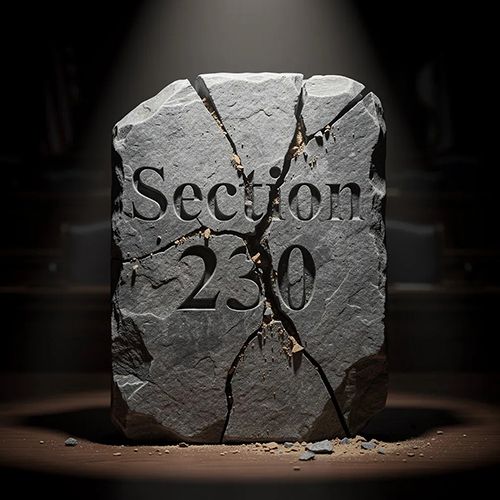
The decision in Doe v. Meta Platforms, Inc., 24-1672 (9th Cir.) appears to be a routine application of Section 230 immunity under well-settled circuit precedent. But two concurrences reflect judicial willingness to reconsider a key term in Section 230 that could reshape modern social media law. The decision and concurrences are less a statement of settled law than a snapshot of a doctrine in flux.
Background on Section 230
Section 230 of the Communications Decency Act of 1996 provides that "[n]o provider or user of an interactive computer service shall be treated as the publisher or speaker of any information provided by another information content provider." 47 U.S.C. § 230. Courts have applied this provision broadly, effectively immunizing editorial decisions, algorithmic content delivery, content recommendations and platform design choices involving third-party speech. Under this framework, platforms such as Meta have obtained immunity from a wide range of lawsuits, including defamation claims and claims premised on materials that third parties post.
The case of Doe v Meta
Plaintiffs are displaced members of the Rohingya community, an indigenous ethnic minority in Myanmar. They allege that Meta, through Facebook, played a role in the Rohingya genocide by partnering with telecommunications companies to pre-load the application onto mobile devices. Plaintiffs allege that Facebook's algorithmic content delivery system promoted "toxic posts" and that Meta adjusted its algorithms to "boost" negative content to maximize engagement and advertising revenue.
The majority decision: Standard doctrine based on binding precedent
Like most courts, the 9th Circuit uses a three-part test to assess Section 230 immunity. The defendant must be (1) a provider or user of an interactive computer service, (2) whom the plaintiff seeks to treat as a publisher or speaker, (3) of information provided by another information content provider.
The significance of Doe v. Meta was its treatment of this second prong. The court held that plaintiffs' objections stemmed from "how Facebook promoted or downplayed third-party posts using algorithms," which constitutes "publishing content" under binding precedent. See, e.g., Doe v. Meta at 13 (citing Doe v. Grindr Inc., 128 F.4th 1148 (9th Cir. 2025)); Dyroff v. Ultimate Software Grp., Inc., 934 F.3d 1093 (9th Cir. 2019), and others).
What is a publication?
Concurring in full because 9th Circuit precedent compelled the result, Judge Marsha Berzon, joined by Judge William A. Fletcher, wrote separately to express her view that precedent has unduly expanded Section 230 immunity. In the absence of precedent, she would have held that "publisher" for purposes of Section 230 "reaches only traditional activities of publication and distribution--such as deciding whether to publish, withdraw, or alter content--and does not include activities that promote or recommend content or connect users to each other." Doe v. Meta at 21 (concurrence, Berzon, J.). She observed that the 9th Circuit's expansive reading of "publication" extends Section 230 immunity to conduct far removed from traditional publishing, enabling platforms to cause serious harm to vulnerable people.
Finally, she urged the full court to sit en banc to reconsider precedent extending Section 230 immunity to content recommendations and user connections, pointing to both an inter-circuit conflict with the 3rd Circuit's decision in Anderson v. TikTok and potential tension with the Supreme Court's recent decision in Moody v. NetChoice.
Original public meaning
Judge Ryan D. Nelson's concurrence opined that the court has "overread Section 230, straying from the original public meaning of the statutory text and creating an all-purpose liability shield for internet platforms." Doe v. Meta at 29. Instead, courts should interpret "publisher" consistent with the substantial body of caselaw applying "the traditional publisher-distributor distinction developed over centuries regarding certain speech torts." Doe v. Meta at 29.
Practically, both judges' approaches lead to similar--but not identical--results. Because Judge Nelson focuses on whether an algorithm performs "'traditional' activities of publication and distribution," Doe v. Meta at 32, he would immunize certain algorithms under Section 230 that Judge Berzon would not. Specifically, the "primitive" algorithms at issue in this case--which were "not tailored to users" and did not "learn from individual users' engagement habits," id. at 35--would receive Section 230 protection under Judge Nelson's framework. Both judges, however, would treat modern algorithms tailored to individual user preferences as falling outside the scope of Section 230 immunity.
The Supreme Court is on the horizon
These concurrences foreshadow what may become the most consequential legal debate about the internet in a generation. Whatever their differences, both Judge Berzon and Judge Nelson would fundamentally reshape Section 230 doctrine; either framework would depart from existing law--stripping immunity from platform conduct that courts have long protected. And while the gap between the two approaches is narrower, it is not insignificant: the scope of remaining protection for algorithmic systems would differ meaningfully depending on which framework prevails.
The Supreme Court has thus far declined every invitation to resolve these questions, passing on Gonzalez v. Google without reaching the Section 230 merits. But a deepening inter-circuit conflict--between the 3rd Circuit's holding in Anderson v. TikTok that a recommendation algorithm constitutes first-party speech and the 9th Circuit's contrary approach--may compel Supreme Court review.
Section 230's shield is under pressure. Platforms should monitor these developments closely, assess how their recommendation systems would fare under a narrower interpretation of "publisher," and prepare for a legal landscape that may look significantly different in the years ahead.
Submit your own column for publication to Diana Bosetti
For reprint rights or to order a copy of your photo:
Email
Jeremy_Ellis@dailyjournal.com
for prices.
Direct dial: 213-229-5424
Send a letter to the editor:
Email: letters@dailyjournal.com