


San Francisco
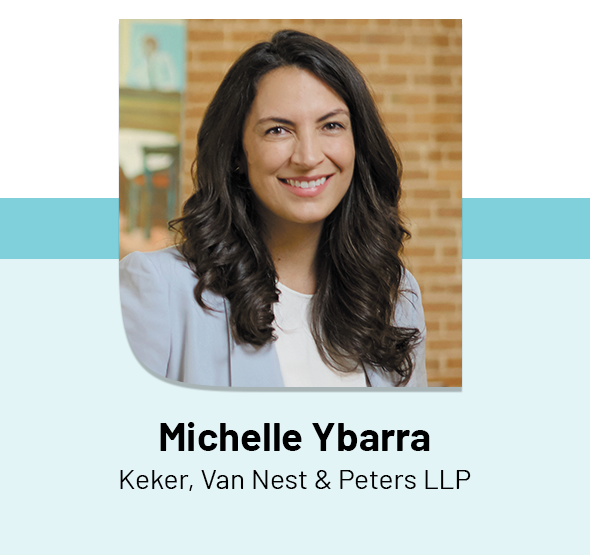
Michelle Ybarra did not come from a family of lawyers. The granddaughter of farmers who never finished high school, she grew up hearing that she should pursue law for a practical reason: she always had a sassy retort. Nearly 18 years into her career, Ybarra has built a practice at the cutting edge of intellectual property litigation, representing clients in cases that are rewriting the rules of copyright, patent and right-of-publicity law.
Her path to IP began at the University of Chicago Law School, where she found herself drawn into debates about whether emerging technologies -- virtual worlds, 3D printing -- demanded new legal frameworks or simply new applications of old ones. "I loved those conversations and the way they challenged my thinking," Ybarra said, "which is probably why I find myself an IP lawyer today."
That disposition has proved well-suited to a moment when courts are confronted daily with technologies that resist easy doctrinal classification. A recurring challenge across her matters has been translation: taking a description of a platform, an algorithm, or a training dataset and rendering it comprehensible to a judge or jury.
"My job is not just to understand the technology, but translate it into clear arguments the courts and a jury can engage with -- in other words, effective storytelling," she said. "In my experience, outcomes often turn on that translation as much as on the legal merits themselves."
The most consequential of her current matters is the copyright MDL against OpenAI. In re: OpenAI Copyright Infringement Litigation, 25-MD-3143 (S.D.N.Y., filed April 11, 2025).
Ybarra has played a leadership role for two years, developing arguments about foundational model training, transformative use and the application of copyright doctrine to generative AI at scale. "The cases raise fundamental questions about how existing legal frameworks apply to foundational model training, transformative use and one of the most consequential technologies of our time," she said.
Also active is a right-of-publicity case involving allegations that an AI system generated a synthetic voice in the likeness of a public figure. Greene v. Google LLC, 5:23-cv-03613 (N.D. Cal., filed Aug. 5, 2023).
Among her recent conclusions, a defense win in Consumeron, LLC v. Maplebear Inc. d/b/a Instacart, 1:21-cv-01147 (D. Del., filed Aug. 6, 2021), stands out. Consumeron brought four patents directed at core features of Instacart's platform. The PTAB found all challenged claims unpatentable in February 2024, and the Federal Circuit affirmed in 2026, canceling every asserted claim.
Ybarra sees a structural mismatch at the heart of IP practice in California: the law cannot keep pace with the technology it is asked to govern. "Litigation remains an important tool for rights holders, but it is expensive, slow and may not provide comprehensive resolution for issues that arise across an entire industry," she said. In the meantime, rights holders are left managing a parallel track -- pursuing litigation while adapting their business strategies to a legal landscape still taking shape.
For reprint rights or to order a copy of your photo:
Email
Jeremy_Ellis@dailyjournal.com
for prices.
Direct dial: 213-229-5424
Send a letter to the editor:
Email: letters@dailyjournal.com