


Civil Rights
May 20, 2026
Louisiana v. Callais weakens Voting Rights Act and opens door to partisan redistricting
Louisiana v. Callais guts key protections of the Voting Rights Act by narrowing Section 2 and enabling partisan redistricting that could sharply reduce Black representation in Congress and state legislatures.


Erwin Chemerinsky
Dean and Jesse H. Choper Distinguished Professor of Law
UC Berkeley School of Law
Erwin's most recent book is "Worse Than Nothing: The Dangerous Fallacy of Originalism." He is also the author of "Closing the Courthouse," (Yale University Press 2017).
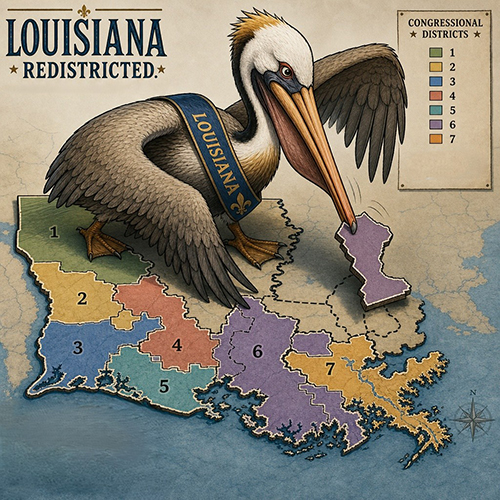
The Supreme Court's April 29 decision in Louisiana v. Callais will mean the largest decrease in Black representatives in Congress and state legislatures since the end of Reconstruction.
It is the six justices appointed by Republican presidents who are helping the Republican party, including making it much easier for Republicans to keep control of the House of Representatives in the 2024 elections and in the future. These justices, almost all of whom consider themselves originalists, used constitutional amendments meant to protect people of color as weapons to disenfranchise them.
There were two crucial aspects to the Court's holding in Louisiana v. Callais--both tragically wrong as a matter of law.
First, the Court nullified Section 2 of the Voting Rights Act, which said that state and local governments could not have election systems with the effect of disadvantaging voters of color. The Court said that there must be proof of racially discriminatory intent, which is enormously difficult to prove because rarely do legislators openly express a racist motive.
Second, the Court said that it is sufficient for a legislature to say that it is drawing election districts to favor a particular political party. Because Black individuals vote Democratic over 90% of the time in Southern states, it will be easy for Republican-controlled state legislatures to engage in redistricting that harms Black voters by saying that the goal is to help Republicans.
We are already seeing this throughout the South, even in states that are in the midst of elections. The Louisiana congressional primary was scheduled for Saturday, May 16, 2026. On April 30, the day after Callais was handed down, Louisiana Governor Jeff Landry suspended the congressional primary, though allowing the primary for other offices to occur on May 16.
Florida passed a new map for congressional districts while its primary process was underway. Tennessee's legislature passed a new map on May 7, even though candidates had to qualify to run in March. South Carolina has moved its congressional primaries from June to August to allow it to redraw congressional districts to help elect an additional Republican to the House of Representatives.
To put this in context, it is the Supreme Court undermining the Fifteenth Amendment and in the words of Justice Elena Kagan "eviscerating" the Voting Rights Act of 1965, one of the most important federal laws adopted during my lifetime.
The Constitution, as drafted and ratified in 1787, had no equal protection clause. This is not surprising because the document had several provisions protecting the rights of owners of enslaved people and none protecting minorities or women. After the Civil War, the Thirteenth Amendment was adopted to abolish slavery. But quickly it was realized that this was not enough. Southern states had rapidly adopted laws depriving Black individuals of all political and civil rights.
In 1868, the Fourteenth Amendment was added to the Constitution to limit what state and local governments could do. Section 1 of the Fourteenth Amendment includes a provision that no state shall deny any person equal protection of the laws. Section 5 empowers Congress to adopt laws to enforce the protections of the amendment. No one disputes that these provisions were especially to protect Black people from discrimination, including by giving Congress broad authority to legislate to adopt legislation to carry out the amendment's purposes.
In 1870, the Fifteenth Amendment was ratified, mandating that the right to vote not be infringed upon on account of race. It too has a provision that grants Congress the power to adopt laws to enforce the amendment.
Unfortunately, the promise of the Fourteenth and Fifteenth Amendments to end racial discrimination in voting went unfulfilled for almost a century. In 1964, only 6.7%of eligible Black individuals were registered to vote in Mississippi. In Alabama, only 18% were registered to vote. Across the states that had comprised the Confederacy, only 43% of eligible Black voters were registered.
The Voting Rights Act of 1965 was enormously successful in dramatically increasing registration and voting among voters of color, as well as significantly increasing the election of people of color to political office. The two most important provisions were Section 2 and Section 5. Section 5 of the Voting Rights Act was a preventative mechanism: it required that jurisdictions with a history of race discrimination in voting to obtain preapproval from the Attorney General before a change in their election systems. But in Shelby County v. Holder, in 2013, the Court declared unconstitutional key aspects of his provision and no jurisdiction has needed to get preclearance ever since.
But the Court offered the reassurance that there was still Section 2, which provides that state and local governments cannot have election systems or practices that discriminate against voters of color. In 1982, Congress amended this to make clear that proof of a racially discriminatory impact is sufficient to establish a violation of the law.
As a result of Section 2, many states --particularly in the South--drew electoral districts that reflected populations of people of color. This was to ensure that districts were not drawn in a way that had a discriminatory effect against racial minorities.
In Louisiana v. Callais, the Court nullified the 1982 amendments to Section 2 of the Voting Rights Act. The Court said it violates the equal protection clause of the Fourteenth Amendment for states to consider race in drawing election districts even when needed to avoid a racially discriminatory impact that would violate Section 2 of the Voting Rights Act.
The Court went even further and said that so long as the government can point to another basis for its districting, such as helping one political party over the other, there would be no violation of Section 2 of the Voting Rights Act. There is a strong correlation between race and political party affiliation, especially for Black voters who overwhelmingly are Democrats. Any time a state wants to discriminate, it can say that its action was based on partisanship and is immune from challenge. Justice Kagan explained that the Court's ruling "will effectively insulate any practice, including any districting scheme, said by a State to have any race-neutral justification. ... Assuming the State has left behind no smoking-gun evidence of a race-based motive (an almost fanciful prospect), Section 2 will play no role."
In practical effect, the combination of the Supreme Court nullifying Section 2 of the Voting Rights Act and its allowing partisan gerrymandering is to replace Black Democratic representatives with White Republicans. Perversely, the Supreme Court is saying that the Fourteenth Amendment, which had a primary goal of protecting Black individuals, prevents enforcement of the Fifteenth Amendment.
The Court's majority was untroubled by this. It said, as it did in Shelby County v. Holder over a decade earlier, that "'things have changed dramatically'" in the South "in the decades since the passage of the Voting Rights Act." But the Court declaring victory over racism cannot eliminate the reality of continuing pervasive race discrimination in voting.
I have long believed that there should be a Hall of Shame for tragically wrong Supreme Court decisions, such as Dred Scott v. Sandford, Plessy v. Ferguson and Korematsu v. United States. Louisiana v. Callais belongs in that Hall of Shame.
Submit your own column for publication to Diana Bosetti
For reprint rights or to order a copy of your photo:
Email
Jeremy_Ellis@dailyjournal.com
for prices.
Direct dial: 213-229-5424
Send a letter to the editor:
Email: letters@dailyjournal.com