


Newport Beach
Cybersecurity & AI
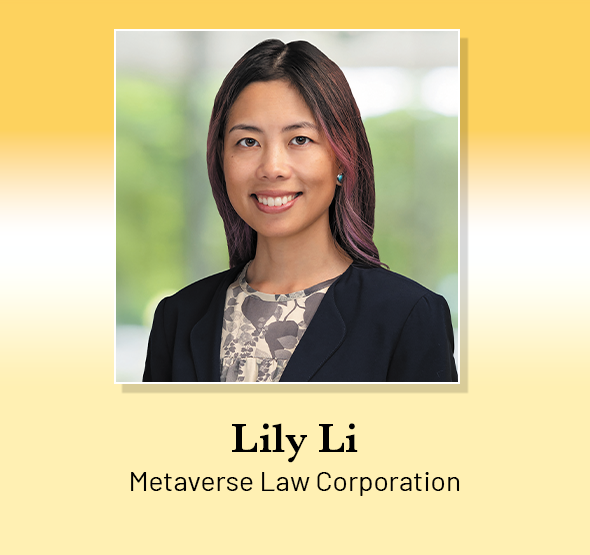
Recognizing a chatbot developer's exposure to online child-safety rules, Lily Li walked the company through a collision of regimes: the FTC's Children's Online Privacy Protection Act, new state age-verification laws and data privacy requirements governing children's information, all converging at once. Li, founder of Metaverse Law, helped the client navigate the overlap. "This allowed the client to meet online safety requirements while complying with data privacy laws governing children's data and staying out of the crosshairs of pending FTC and state investigations," she said.
That kind of layered problem runs through much of Li's caseload. "I advise high-growth startups, multinationals and public corporations across industries, including cloud computing, generative AI, fintech, health care IT and AR/VR gaming," she said. Li guides compliance with the California Consumer Privacy Act, the General Data Protection Regulation, the European Union's AI Act, HIPAA, GLBA and a growing list of state AI laws.
Recent matters show the range of her work. A registered lender hired her firm for a review spanning the CCPA, the Gramm-Leach-Bliley Act and state insurance requirements, producing policies, training, and manuals that let the in-house team deploy a privacy program across the organization. A mobile app in the female wellness space brought her in to audit website, cookie, pixel and app store compliance, work that reduced exposure amid a surge of wiretap and pen register litigation nationwide. A health care plan retained her to build an AI governance program layering HIPAA and state medical privacy law over new AI regulatory requirements. "This allowed the health care plan to stay ahead of new regulatory requirements in 2026, reducing compliance headaches in responding to annual regulatory reviews and audits," Li said.
Li founded Metaverse Law in 2018 after practicing litigation at Brown Wegner LLP, where partners William Brown and Matthew Wegner backed her move into privacy and AI law, lending her office space to launch the firm. She built Metaverse Law as one of the first fully remote privacy practices in the country, recruiting talent without regard to location and folding research and compliance tracking tools into the firm's workflow.
Much of the challenge, she said, sits outside the law itself. "The biggest obstacle is less about providing legal advice, but finding the right people at the organization to act on that advice," Li said. IT and information security, product and development, marketing and sales each hold a piece of the puzzle and Li spends much of her time coordinating between them. "Finding the company's champions and managing compliance projects to their implementation is half of the job," she said.
Li has also turned her attention to AI's reach into classrooms, where tools increasingly collect neural data tied to brain activity, cognitive processes and emotion. She published "Safeguarding Neural Data in the Age of EdTech" in the California Lawyers Association's Privacy Law Journal in February 2026, warning that "classrooms could become one of the first places society normalizes AI-driven cognitive surveillance."
She also flags a rise in surveillance and individualized pricing, where algorithms set prices based on a consumer's behavior or perceived willingness to pay, a practice now drawing scrutiny from lawmakers at the federal, state and international level.
For reprint rights or to order a copy of your photo:
Email
Jeremy_Ellis@dailyjournal.com
for prices.
Direct dial: 213-229-5424
Send a letter to the editor:
Email: letters@dailyjournal.com