


Real Estate/Development
Aug. 25, 2026
Towards a more perfect partition
California's 2023 partition law was well intentioned, but it overlooked how California property law actually works. A 2026 update can fix those oversights and create a more perfect partition.



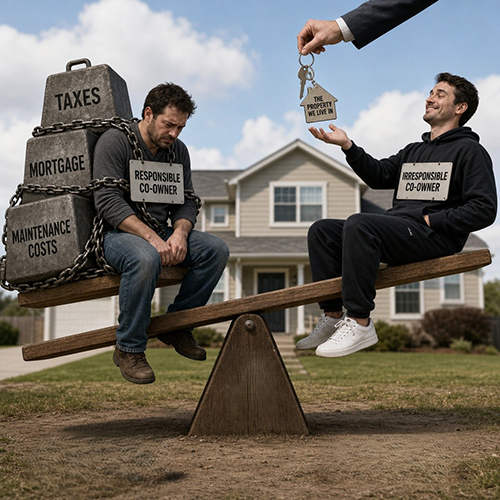
California is not Alabama, and the TransAmerica building is not a family farm in eastern Ohio. A recent change to the partition law, however, treats all of these things as the same. If you listen to any business or real estate commentator of any stripe, they will begin with the premise that California has more regulations, more laws, than almost any other state. The recently adopted partition law, however, acts as if this is not true.
Nevertheless, unlike Marc Antony, I come not to bury the partition law but to praise it. As a basic premise, it is time for California's partition law to be updated. Enacted 50 years ago, in 1976, the main part of the partition law is based on not just a different time, but really, a different state of the State. That partition law contains 106 different and unique statutes to address the issues arising in the California that existed at that time. A California moving from an agrarian past toward a global economic powerhouse with all the real estate development and agricultural transformation that would entail.
As it stands, the 2023 addition to the partition law (AB 633 '21-'22), does the exact opposite of its premise. Basically, it just slapped 13 new laws that sit on top of the preexisting 110, without even the slightest attempt to harmonize them or explain the inconsistencies. While the recent enactments are well intentioned, because of these oversights, it is necessary for the Legislature to enact clean-up legislation to ensure that its purpose is actually effectuated by adopting the Standard Partition Law.
Specifically, the intent of the 2023 addition (AB 633 '21-'22) was to ensure that co-owners sued for partition of agricultural property could have the opportunity to keep their property before it was sold. Because the 2023 addition was based on the laws of Alabama and Ohio, it appears it overlooked two key things: first, in California, agricultural property was already subject to partition in kind, meaning that severing a portion of the land, rather than selling the entire property, was actually preferred under the prior law. Second, the 1976 partition law already provided a co-owner who was sued for partition with the ability to buy the property through a technique known as a full credit bid. That is, at least in California, the law attempted to fix what was not really broken.
That said, at least based on the academic literature, the theory for the 2023 addition (AB 633 '21-'22) to the partition law was that co-owners were forced to sell to investors at below-market value because there was no mechanism to achieve a buyout at a fair price. This is a fair innovation, but then again, because the 2023 addition utterly fails to account for the California Code of Civil Procedure or substantive real estate law, it actually makes it less attractive for a co-owner to exit than a sale of a portion to a third party. That is, the 2023 addition actually makes it more likely that a party would do the exact thing it was not intended to do.
Similarly, the 2023 addition (AB 633 '21-'22) is based on the premise that co-ownership situations often break down because of one fundamental reality of property: bills. That is, the law totally lacks a mechanism to force one co-owner to pay for common expenses for co-owned property, such as property taxes, the mortgage or maintenance.
For example, partition often arises because one co-owner stops paying for the taxes or mortgage, and over time, a tax sale of the property or a foreclosure becomes increasingly likely where one person is forced to pay the bills that should be borne by at least two or maybe even three people. While apparently no one is advocating not to pay the taxes or take responsibility for a mortgage, because of the co-ownership situation, oddly, somehow partition becomes the scapegoat, even though totally eliminating the law of partition would not solve this fundamental problem.
The blind spot with the 2023 addition is that it is equally likely that the person living at the property is contributing to all the expenses as the person not living at the property. The 2023 addition, (AB 633 '21-'22), without any explanation or basis whatsoever, envisions only that the out-of-possession owner is the one paying all the bills.
This oversight matters because, in many cases, the responsible co-owner wants to separate from the irresponsible one to preserve the property they have worked so hard to support. Perversely, the 2023 addition allows the irresponsible co-owner--the one who benefited from the responsible owner's hard-won contributions--to buy the property through a smoother transaction. This just adds insult to injury.
While in theory this leads to the intended result that the property "stays" in the family, at least temporarily, it actually makes it more likely that the property is then sold by the irresponsible party--again, the premise is that this person doesn't care for the property, doesn't want to contribute, and just wants it for cash--to then flip it. That is, the 2023 addition makes it more likely that the exact harm it wanted to redress actually comes to pass.
The solution to these accumulated problems--the outdated 1976 partition law, the 2023 addition's failure to account for California civil procedure, the advantage it gives the irresponsible party, and the responsible party's interest in preserving ownership--is a legislative update. California would benefit from a 2026 revision to the partition law. After 50 years, much has changed. The Legislature should adopt the Standard Partition Laws described in the California Real Property Journal. Doing so would fully carry out the purpose of the 2023 addition while making the law easier, fairer and more workable for Californians. It would be a more perfect partition.
Submit your own column for publication to Diana Bosetti
For reprint rights or to order a copy of your photo:
Email
Jeremy_Ellis@dailyjournal.com
for prices.
Direct dial: 213-229-5424
Send a letter to the editor:
Email: letters@dailyjournal.com