


Civil Procedure
Sep. 9, 2026
Summary judgment strategy: Write the separate statement for two audiences
An ironclad separate statement of undisputed material facts can persuade the court while giving opposing counsel a sobering perspective on the strength of the case.



Marshall J. Shepardson
Senior Motion and Appellate Counsel
Fraser, Watson & Croutch, LLP.
New York Univ SOL; New York NY
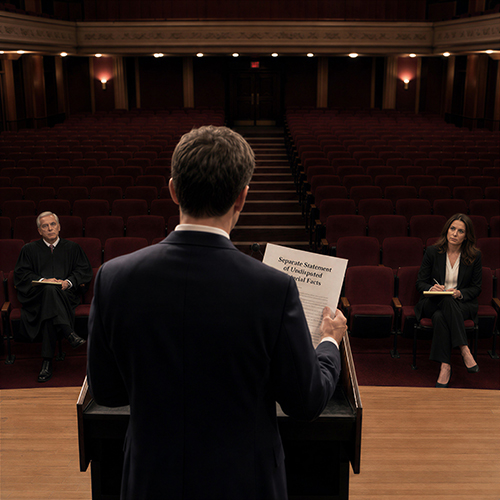
The audience for every motion for summary judgment will include a judge and maybe a clerk or briefing attorney. However, the primary audience, who will read the motion earliest and most intently, is the opposing attorney. Winning over that hostile audience is the writer's opportunity to prevail without a costly contest. A movant may ultimately need to persuade the court that the case has no merit, but the best possible outcome is to persuade opposing counsel that mounting an opposition just isn't worth the effort...or expense.
Despite being treated frequently as an afterthought, the separate statement of undisputed material facts, or SSUMF, is the most important and potentially the most persuasive component of the MSJ. Especially in expert-driven areas of law, such as medical malpractice and products liability, defense counsel should craft the SSUMF with an eye toward catering to his or her hostile audience: opposing counsel. (This without, of course, forgetting about the judge!)
The SSUMF should be a series of objective, documented assertions. Each one should be self-contained, self-explanatory and "bite-sized," meaning no compound or run-on narratives. The SSUMF should lay out all the facts that the moving party's experts will rely on, in a fashion that is completely free of argumentative language.
Each assertion should be effortlessly digestible by a court and opposing counsel. Judges and opposing attorneys may be very intelligent--even brilliant--but they are not all-knowing. Therefore, the rule of thumb is that if you don't know what it means, the audiences probably won't either. A sprawling, cut-and-paste data-dump of undefined industrial jargon, cryptic acronyms and pharmaceutical brand names makes no headway toward persuading either audience.
Look up technical concepts and define them in lay terms. Spell out acronyms. Unpack medical abbreviations. Succinctly note the nature and purpose of each drug. Judges, in particular, will be new to a case and will be learning everything about it for the first time when they review the SSUMF. Opposing counsel, too, may have gaps in their background knowledge of medicine and engineering when they have not yet crammed for trial. Methodically spelling out technical data in intelligible terms is an opportunity to depict the facts in a new light for opposing counsel's benefit. When your adversary is learning the case from you, you have the advantage. If you are willing to crack your medical dictionary, neither the judge nor your counterpart will need to, and you will become the authority. The court will begin taking quasi-judicial notice of your version of events, and opposing counsel may start thinking dispassionately about the case for the first time.
However, medical or scientific explanations that go beyond cut-and-dry definitions are not suitable for the separate statement because they will be susceptible to at least some degree of dispute. Deeper exposition should be reserved for the expert declaration. Otherwise, by including a fact in the SSUMF, you will have conceded that the fact is material. Nazir v. United Airlines, 178 Cal.App.4th 243 (2009). In Nazir, the Court of Appeal adopted the emphatic "Practice Pointer" in the Rutter guide that "if a triable issue is raised as to any of the facts in the separate statement, the motion must be denied!"
Therefore, the SSUMF needs to exclude every off-handed aside, esoteric exegesis and freewheeling digression that an expert might insist on including in the declaration. Each one only makes it that much easier to create a genuine dispute. Experts' commentary should be treated as "expert dicta." Like judges' dicta, it may be elucidative as to the reasoning for the ultimate conclusion, but it is not the operative opinion itself. Such expert dicta is not only unnecessary to include in the SSUMF but also dangerous to include under Nazir.
On the other hand, make sure you don't leave out the expert's ultimate opinions. Those are certainly material facts for the purpose of the MSJ because they are what will shift the burden of production. After all, under the "Golden Rule" of MSJ, "if it is not set forth in the separate statement, it does not exist." United Cmty. Church v. Garcin, 231 Cal.App.3d 327 (1989).
If the other side winds up electing to oppose the motion, what the judge should expect to see in the SSUMF response is a series of the word undisputed in the righthand column, all the way down to the experts' ultimate opinions. The entry of disputed in response to the ultimate opinions would need to be backed up with citations to an opposing expert's declaration, voicing a contrary opinion. To have evidentiary value, such an opposing declaration would need to pass the judge in "gatekeeper" mode by providing a reasoned analysis that leads to a contrary opinion, even though all the other material facts are undisputed. Sargon Enterprises, Inc. v. University of Southern Cal., 55 Cal.4th 747(2012) .
Knowing this, the would-be opposing attorney should be sobered by scanning your SSUMF. Prudent opposing counsel will know that the judge will not mistake diversions, semantics or non sequitur for a genuine triable issue. Therefore, to defeat the motion, an expensive contrary opinion will need to be developed. Furthermore, the best-case scenario for the opposing side is that the case goes to trial, where the expert will become even more expensive while none of the underlying objective facts will change. An effective separate statement presentation should give the hostile audience a strong incentive to seek out easier prey.
Submit your own column for publication to Diana Bosetti
For reprint rights or to order a copy of your photo:
Email
Jeremy_Ellis@dailyjournal.com
for prices.
Direct dial: 213-229-5424
Send a letter to the editor:
Email: letters@dailyjournal.com