


Technology
Sep. 15, 2026
AI misuse reported in over 2000 cases worldwide. What's a lawyer to do? (Part 1)
As courts abandon the grace period for AI mistakes, lawyers face sanctions, new disclosure rules and a growing duty to verify AI-generated work. Here are three steps firms can take to reduce the risk.




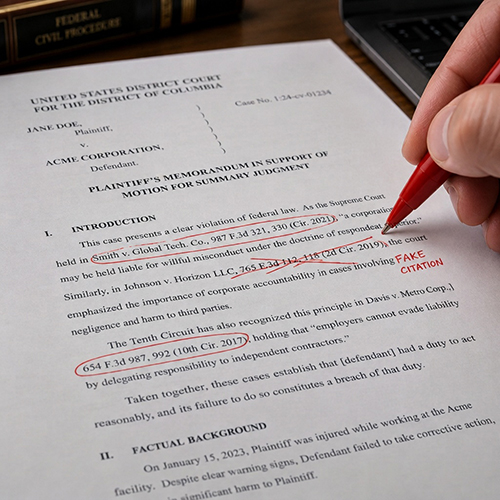
Last month, the LA Times reported on a story which received a lot of traction. An attorney for State Farm Insurance Company, in litigation over a coverage for a house in Carson damaged by fire, apologized to LA Superior Court Judge Elizabeth Bradley for submitting motions in limine for an October trial rife with fabricated cases.
The case? Fa'alagilagi Meni-Siliga v. A's Contractor, Inc, 24-CMCV01105 (Cal. Super. Ct. L.A. County). The specifics? The insurance company's lawyer was chastised for citing to seven imagined or "nonexistent" cases, as well as including multiple faulty quotations and incorrect citations, purporting to support the position that State Farm was not obligated to fully reimburse the homeowner.
So outraged were members of the public that at least one letter to the editor on the subject was published by the Times. Former attorney Harvey Miller of Pasadena wrote on Aug. 23, 2026, that even before AI, "I never filed case law authority without actually reading the [actual] court decision . . . What is going on in today's legal world that allows a machine to produce phony law that is used in court?"
Someone in Sacramento must have read about the State Farm case and the many before it. On Monday, Aug. 31, 2026, the California assembly, 75-0, passed Senate Bill 574, which requires all California attorneys to disclose AI use to court for all submitted documents. The bill is awaiting assent or veto by Gov. Newsom.
What happened in LA's State Farm case is not isolated. As of Sept. 13, 2026, worldwide, just over 2,000 cases have issued reporting AI violations. Of those, 1,396 are from the U.S., with other countries such as Australia (110), Netherlands (7) and South Korea (4) reporting "AI hallucinations" in some order, opinion or other legal document.
The cases against lawyers are racking up. And attorney Miller's sentiments are echoed by reviewing courts.
· In Noland v. Land of the Free, L.P., 114 Cal.App.5th 426 (2025), in a memorandum opinion, the California Court of Appeals rebuked lawyers for submitting appellate briefs with 21 fabricated quotations and inaccurate citations. Counsel admitted to using ChatGPT and other AI platforms to "enhance" drafts and admitted failing to check the enhanced briefs before filing them. The court imposed $10,000 in sanctions, holding that attorneys cannot rely on fabricated AI-generated authorities and cannot delegate their citation verification duty to third parties or to AI tools.
· In Del Biaggio v. Bansen, 121 Cal.App.5th 831 (2026), the California Court of Appeals addressed an appellate brief containing multiple fictitious AI-generated case citations. The attorney characterized his use of AI as a "communication error" with his paralegal who was to check the contents. The court imposed sanctions of $1,500 and held that the attorney's use of a paralegal to verify citations violated the new (2026) California Committee on Professional Responsibility and Conduct (COPRAC)'s Practical Guidance for the Use of Generative Artificial Intelligence in the Practice of Law, which imposes a non-delegable duty on a lawyer to verify all outputs of AI, including citations.
· In Coomer v. Lindell, et al., U.S. District Court of Colorado (2025), a federal judge in the My Pillow voting machine litigation, sanctioned attorneys $3,000 for submitting a brief containing "nearly thirty defective citations" generated by artificial intelligence. The court rebuked the lawyers for submitting a brief that "misquoted cited cases, misstated the holdings, cited cases for legal principles not discussed in those cases, misidentified the courts and cited non-existent cases."
Christine King, a lawyer representative for LexisNexis who trains federal prosecutors, has explained that courts were initially lenient when the use of AI technology in legal matters was novel, admonishing lawyers instead of imposing sanctions. See, Ex parte Lee, 673 S.W.3d 755 (2023); Ruggierlo, Velardo, Burke, Reizen & Fox, P.C. v. Lancaster, Slip Copy (2023); and Jaylen Frier v. Jeffrey Hingiss, et al., U.S. District Court Eastern District of Wisconsin, (2023).
Now, almost four years after the November 2022 public launch of ChatGPT by OpenAI (with GPT version 3.5), courts are more consistently imposing sanctions on lawyers for the faulty reliance on unverified AI. King states that "in 2026 the tone of the courts has hardened with no more grace period for new technology and zero tolerance for hallucinations." See, Fletcher v. Experian Info. Sols., Inc., 168 F.4th 231, 235 (5th Cir. 2026) (Sanctions imposed with the warning that "[I]gnorance of the risks of using generative AI without verification is no longer an excuse.")
How can lawyers and law firms survive the AI gauntlet? Three of seven tips
AI is endemic. Horror stories for lawyers abound. What steps can a lawyer or law firm take to reduce the risk of being a cover story in a newspaper or being sanctioned? Here are three of seven tips. The other four will be reported tomorrow.
1. Advise clients and potential clients that if they use AI to research a topic, their communications are not privileged and can be used against them in litigation
Advise clients and potential clients not to use AI to research the law and, if they do, for them to understand that those searches will likely be discoverable by the opposing party in litigation. In United States v. Heppner, 820 F. Supp. 3d 292 (S.D.N.Y 2026), Heppner was informed that he was a target in a New York federal criminal securities fraud investigation and hired criminal counsel. In anticipation of working with his lawyer, but not at his lawyer's direction nor with the knowledge of his lawyer, Heppner used AI platform Claude to research defenses to white-collar fraud cases. Subsequently, Heppner was arrested, and the FBI seized and searched his computer and found multiple incriminating prompts and responses. The federal prosecutor sought to introduce the materials in the criminal case as the defendant's admissions. Counsel for Heppner argued that the AI information was protected by the attorney-client and work-product privileges. The Federal District Court for the Southern District of New York, in an oral ruling and shortly thereafter in a written order, held in what it called "a matter of first impression," that documents generated through AI, and not at the direction of counsel, are not privileged. The court cautioned that AI's "novelty does not mean that its use is not subject to longstanding legal principles..."
2. Train lawyers and staff on AI use, document generation and verification
California Bar Rule 1.1 commentary advises lawyers of "the duty to keep abreast of the changes in the law and its practice, including the benefits and risks associated with relevant technology." This, when coupled with the 2026 Proposed Amendments to the Rules of Professional Conduct Related to Artificial Intelligence by COPRAC (Committee on Professional Responsibility and Conduct), imposes a duty on all lawyers (and arguably law firm staff) to take AI training. However, having AI training programs at a law firm does not always prevent AI misuse. White-shoe New York law firm Sullivan & Cromwell held AI training at their firm, but some of their lawyers and staff failed to heed the training. This failure caused a senior lawyer at the firm to alert a bankruptcy judge in April 2026, in re Prince Global Holdings Ltd., No. 26-10769 (MG) (Bankr. S.D.N.Y. Apr. 18, 2026), of the law firm's failure to cite check in an AI-generated emergency bankruptcy motion. The firm self-reported not just that it used AI that had fabricated case citations, misquoted authorities and included propositions based upon non-existent legal cases, but also that it had not followed its established AI training protocols that required verification.
3. Stay abreast of ever-evolving bar rules and local rules on use of AI
LexisNexis has a generative AI tracker that keeps a running list of state and local (court, ABA and bar association) AI rules from across the country. Some courts have issued their own local AI rules. For example, the chief judge of the U.S. District Court in Maryland, on Aug. 5, 2026, issued a Standing Order on AI Use. It states that fake or hallucinated citations, quotations or representations may lead to FRCP Rule 11 sanctions, including "striking the filing, imposing filing restrictions, monetary sanctions, dismissal of a party's case and any other sanction deemed appropriate by the presiding judge." The order states the obvious: that all lawyers and unrepresented parties must verify the accuracy of the contents of all submissions before filing. All lawyers and law firms must keep abreast of the ever-changing AI rules. While the ABA has not yet made disclosures of AI use mandatory to clients, it advises that even where there is no court or bar rule warranting disclosure, that "disclosure is often still the better approach."
Stay tuned for tips four through seven tomorrow in the Daily Journal. We will report on what happened last Friday in the State Farm Carson fire case. HINT: Sanctions were imposed.
And by the way, no AI was used in the creation of this article and all propositions and cites have been verified by each of the co-authors.
Submit your own column for publication to Diana Bosetti
For reprint rights or to order a copy of your photo:
Email
Jeremy_Ellis@dailyjournal.com
for prices.
Direct dial: 213-229-5424
Send a letter to the editor:
Email: letters@dailyjournal.com