


Wills, Estates & Trusts
Sep. 24, 2026
Beyond probable cause: When no-contest clauses are strictly enforced
For beneficiaries considering a challenge to an estate plan, the substantive strength of a claim may not be enough to protect an inheritance from forfeiture.



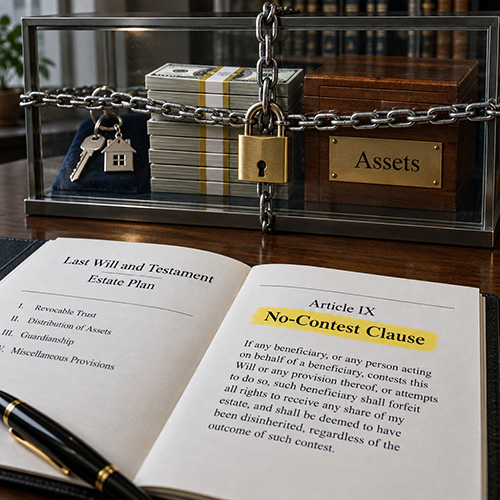
No-contest clauses in a decedent's estate plan present beneficiaries with a consequential choice: if they challenge an estate plan or otherwise engage in prohibited activity covered by the plan's no-contest clause, then they risk forfeiting their inheritance. California law generally tempers that risk by exempting certain contests that are supported by probable cause from the reach of a no-contest clause. But that protection is not absolute; there are several instances in which no-contest clauses will be strictly enforced, regardless of whether there was probable cause to support the challenged action.
Probate Code section 21311 identifies two categories of claims that may trigger a no-contest clause, without regard to probable cause. And in Meiri v. Shamtoubi, 81 Cal.App.5th 606 (2022), the Court of Appeal identified another circumstance in which probable-cause protection provides no practical safeguard: a direct contest to an estate planning document filed after the applicable statutory deadline.
The statutory framework
Section 21311 limits enforcement of no-contest clauses to three categories. The first is a "direct contest" brought without probable cause. Under section 21310, a direct contest includes challenges to a protected instrument based on grounds such as lack of capacity, fraud, undue influence, revocation and forgery. Probable cause exists when the facts known to the contestant at filing would cause a reasonable person to believe there is a reasonable likelihood the requested relief will be granted after further investigation or discovery.
The other two categories operate differently. Section 21311(a)(2) permits enforcement of a no-contest clause against a pleading challenging a transfer of property on the ground that the property was not the transferor's property at the time of transfer. And section 21311(a)(3) permits enforcement of a no-contest clause against a party who has filed a creditor's claim or an action based on it. In both circumstances, the no-contest clause at issue must expressly provide for that application. Neither provision includes a probable-cause safe harbor. In other words, if the no-contest clause specifically prohibits a beneficiary from filing a creditor's claim against the decedent's estate or challenging a transfer on the ground that the property was not owned by the decedent, a beneficiary who engages in either form of prohibited conduct could be subject to the no-contest clause, regardless of the beneficiary's good-faith belief or the circumstances underlying the action.
Thus, for these two categories of claims, if the no-contest clause in the subject estate plan does not expressly cover the claim, forfeiture is unavailable under those provisions, but if it does, the statute does not provide the beneficiary a separate probable-cause defense.
When timing eliminates probable cause
Even where section 21311(a)(1)'s probable-cause protection applies (i.e., to the filing of a direct contest against a protected instrument), the substantive strength of a beneficiary's claims may not matter. In Meiri, supra, the Court of Appeal held that a direct trust contest filed after expiration of the permissible statutory period to file such a claim necessarily lacked probable cause--without any consideration of the substantive merits of the contest.
Meiri sought to invalidate a trust based on undue influence and fraud. Before she filed her contest, however, the trustee had served the notification required by Probate Code section 16061.7. Section 16061.8 generally gives a beneficiary 120 days after service of that notification to contest the trust. Meiri filed her contest approximately 230 days later.
The trustee sought to enforce the trust's no-contest clause against Meiri. The trial court found that Meiri had brought a direct contest without probable cause and ordered that her rights under the trust be determined as though she had predeceased the trustors without surviving issue. The Court of Appeal affirmed.
The court focused not on the strength of Meiri's evidence in her contest but on section 21311(b)'s requirement that there be a reasonable likelihood the requested relief will be granted. Because her contest was already barred by her failure to file it prior to the expiration of the 120-day deadline, the court reasoned that there was no reasonable likelihood that she would obtain the requested relief. The court therefore held that the untimely filing of the contest--in and of itself--established a lack of probable cause for purposes of enforcement of the trust's no-contest clause, regardless of the potential merits of the underlying allegations.
That conclusion also disposed of Meiri's argument that an evidentiary hearing was required before enforcing the no-contest clause. Once the court determined that the time-barred litigation constituted a direct contest without probable cause, the evidentiary-hearing issue was moot. In practical terms, additional evidence supporting the substantive contest could not cure the procedural defect.
Meiri differs from sections 21311(a)(2) and (a)(3). Those provisions omit probable cause from the inquiry altogether when the instrument expressly covers the conduct. Meiri, however, still applies the probable-cause requirement, but shows that a procedural bar can resolve it as a matter of law before the merits are even considered.
The consequences can be harsh. A beneficiary may possess a factually strong claim yet still forfeit an inheritance simply because the claim falls within an expressly covered statutory category or because a procedural defect makes relief legally unavailable. For counsel evaluating a potential contest, the lesson is straightforward: analyze not only the merits but also the precise no-contest language and every applicable procedural deadline before filing.
Submit your own column for publication to Diana Bosetti
For reprint rights or to order a copy of your photo:
Email
Jeremy_Ellis@dailyjournal.com
for prices.
Direct dial: 213-229-5424
Send a letter to the editor:
Email: letters@dailyjournal.com