


Government
Oct. 2, 2026
He napped on a courthouse bench. Now he's asking voters to keep him on one.
Justice Victor A. Rodríguez of the 1st District Court of Appeal, who spent his career in public service and ran Alameda County's first dedicated domestic violence courtroom, faces voters for a full 12-year term.


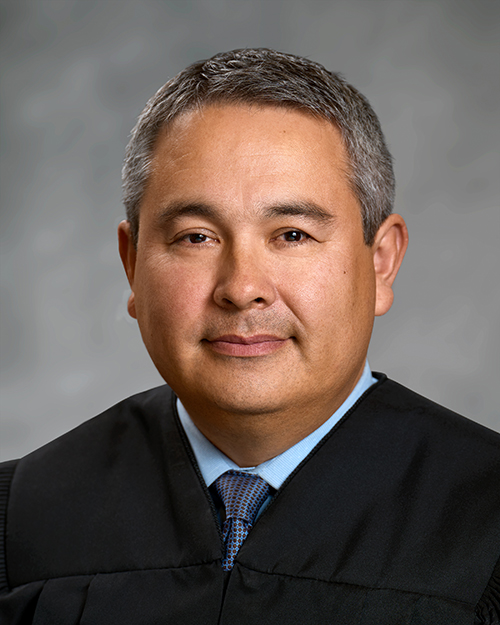
As a boy, Justice Victor A. Rodríguez sometimes fell asleep on a courtroom bench in Livermore while his parents cleaned the building late at night. Next month, voters in 12 Northern California counties will decide whether he keeps his seat on the 1st District Court of Appeal.
"There's this circular notion to life sometimes," Rodríguez told the Daily Journal in 2019, recalling his childhood nights in the courthouse. "Becoming a judge just felt right in terms of following that path."
Rodríguez has served on Division Three since October 2021 and is seeking a full 12-year term on the Nov. 3 ballot. Voters retained him in 2022 to complete his predecessor's term.
Rodríguez has never worked at a law firm. After graduating from UC Berkeley School of Law in 2003, he was a Skadden, Arps, Slate, Meagher & Flom LLP fellow at the Mexican American Legal Defense and Educational Fund and then clerked for U.S. District Judge Consuelo B. Marshall of the Central District.
He then spent nearly 12 years as a staff attorney at the California Supreme Court. Gov. Jerry Brown appointed him to the Alameda County Superior Court in 2017. He started in family law, which he called the best possible training for a judge.
He later presided over the county's first dedicated civil domestic violence restraining order department in Hayward. Most litigants before him were self-represented, and he routinely explained their rights and the process.
"Most people who leave his courtroom leave feeling good, even if they didn't get what they wanted," attorney Teresa K. Francis said in 2019.
That family law and domestic violence experience surfaced in Irvine v. Irvine (2026), which Rodríguez wrote two weeks ago. The court filed it Sept. 18, a day after oral argument. It held that a domestic violence restraining order respondent is not automatically entitled to a continuance because testifying could incriminate her in a pending criminal case. Courts must weigh that burden against the harm of delay and the Domestic Violence Prevention Act's aim of quick resolution, he wrote.
The panel upheld a restraining order against a woman charged with biting her ex-husband after she had called him more than 1,000 times in seven hours.
His opinions have ranged well beyond family law. Several turn on which governmental actor has authority and what the governing law permits.
That question was central to Regents of the University of California v. Superior Court (Parnassus Neighborhood Coalition) (2024), in which the panel ordered a San Francisco judge to sustain the Regents' demurrer to a neighbors' suit against UCSF's planned hospital at its Parnassus Heights campus. Because the hospital advances the university's academic mission, the Regents were acting in a governmental capacity and are exempt from local building and zoning rules, Rodríguez wrote. Both this opinion and Irvine were filed a day after oral argument.
A dispute over the reach of California's anti-discrimination law arose in Ison v. Lara (2026). Rodríguez's opinion upheld a 1996 regulation letting auto insurers use marital status as a rating factor. The petitioner argued the regulation conflicts with the Unruh Civil Rights Act, which Proposition 103 incorporates and which was amended in 2005 to bar marital status discrimination. The Unruh Act defers to conflicting laws, he wrote.
Taxing authority was at issue in Garcia-Rojas v. Franchise Tax Board (2026). Rodríguez reversed a summary judgment for the board, which had taxed a Texas radiologist who remotely read images for a California medical corporation, arguing he ran a unitary business inside and outside the state. A sole proprietor doing one job for one company has no multiple businesses to unite, Rodríguez wrote.
The court sided with a woman removed from a sheriff's work release program after morning sickness caused her to miss shifts in In re Riley (2025). Only the sheriff could end her participation, Rodríguez wrote, and nothing in the record supported the trial judge's finding that she could no longer take part.
Laurinda Keys
laurinda_keys@dailyjournal.com
For reprint rights or to order a copy of your photo:
Email
Jeremy_Ellis@dailyjournal.com
for prices.
Direct dial: 213-229-5424
Send a letter to the editor:
Email: letters@dailyjournal.com