


Constitutional Law
Oct. 5, 2026
St. Mary Catholic Parish v. Roy: Supreme Court to clarify religious exemptions
The Supreme Court will consider whether Colorado's preschool funding requirements and exemptions violate the Free Exercise Clause by treating religious schools differently from certain secular participants.


Kevin T. Snider
Chief Counsel
Pacific Justice Institute
Email: ksnider@pji.org
National Univ SOL; San Diego CA
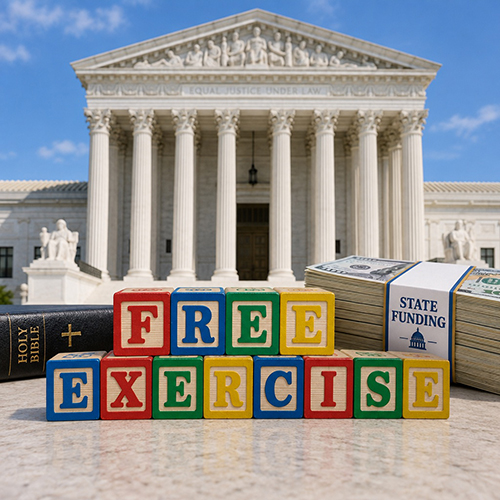
The Supreme Court has granted the petition for certiorari in St. Mary Catholic Parish v. Roy, a case involving the denial of state funding to parochial preschools. Lawyers and academics hail St. Mary as a needed vehicle to clarify what it means for a law to be generally applicable under the Free Exercise (of religion) Clause.
Colorado created a universal program so that children can attend preschool free of charge for up to 15 hours per week. Families can use government funding to send their child to a participating preschool of their choice, including faith-based options. Schools are eligible for the program if they meet certain government standards, such as teacher qualifications and class sizes. Preschools must also comply with an "equal opportunity mandate." The mandate requires that "each preschool" "provide eligible children an equal opportunity to enroll and receive preschool services regardless of race, ethnicity, religious affiliation, sexual orientation, gender identity, lack of housing, income level, or disability."
But here, "equal" is not what it seems due to two regulatory carve-outs for special education students and Head Start preschools. Beyond those two exceptions, preschools can request permission of the state to allow for preferences for certain types of children who fit the school's program or specific community interests. For example, Colorado will approve a preschool that limits enrollment to "gender-nonconforming children," or "prioritize[s] children of color," or "grant[s] preference to a child based on the child or family being part of the LGBTQ community." However, no faith-based provider is allowed an exemption on the basis of religious affiliation. This rule prevents Catholic preschools from receiving state funding if they retain their Catholic character. A group of parochial preschools brought a First Amendment challenge.
The 10th Circuit determined that the funding system does not violate the free exercise of religion because the equal opportunity mandate is a generally applicable law, applying equally to all preschools--secular or sacred. The panel relied on Employment Div. v. Smith, 494 U.S. 872 (1990), which held that laws burdening religious exercise that are "neutral" and "generally applicable" are subject only to rational basis review. In 2021, a pair of Supreme Court opinions identified two ways in which a law steers off course in relation to general applicability. In sum, a law is not generally applicable when it contains categorical or discretionary exemptions.
First came a pandemic case where California placed public health restrictions on gatherings. But not all of them. The governor made some categorical exceptions. In compiling those categories of places where gatherings were allowed, religious institutions and people of faith landed on the naughty list. Due to the exceptions in the public health orders, the Court determined the restrictions were not generally applicable, writing, "[t]he government may not treat comparable secular activity more favorably than religious exercise." Tandon v. Newsom, 593 U.S. 61, 62, (2021) (per curiam).
Later that year, the Court determined that a regulation also fails general applicability when it uses a "mechanism for individualized exemptions." In other words, when the government creates a formal mechanism for granting exceptions, a policy is no longer generally applicable. Fulton v. City of Phila., 593 U.S. 522, 537 (2021).
St. Mary presents the Court with two issues relative to general applicability. One is whether the carve-outs for Head Start and special education are comparable to parochial preschools per Tandon. The other is whether the state's case-by-case granting of individualized exemptions to preschools makes the program fall short of a generally applicable law, as was the case in Fulton.
Like the pantheon of Hindu gods, California has approximately 156,000 statutes and over 420,000 regulations. Because state lawmakers routinely codify exemptions within statutes, and regulators create mechanisms for individualized review, St. Mary could bring a more robust level of scrutiny to state assertions that a law is generally applicable. Religious institutions and people of faith who find themselves outside the means of regulatory grace have been turning to the courts for relief. With scores of litigants in state and federal courts throughout California testing the limits of Smith, and now Tandon and Fulton, plaintiffs' attorneys hope that St. Mary will find favor with the high court.
Submit your own column for publication to Diana Bosetti
For reprint rights or to order a copy of your photo:
Email
Jeremy_Ellis@dailyjournal.com
for prices.
Direct dial: 213-229-5424
Send a letter to the editor:
Email: letters@dailyjournal.com