


Environmental & Energy
Oct. 12, 2026
Shadows and student parties: How CEQA litigation lost the plot, and Prop. 45 fixes it
Prop. 45 takes on the CEQA paralysis keeping affordable homes and essential projects from getting built.


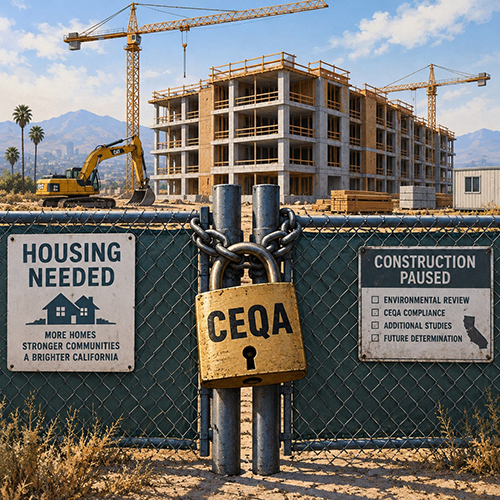
California is closed for business.
Not long ago, more than 200,000 people came here each year. They came from dozens of countries, as close as Mexico and as far as India. There were homemade babies too, thousands of them, born into one of the most educated, richest, diverse and beautiful places in the world.
Not anymore.
For about 20 years, population growth slowed. When the pandemic hit, the great exodus followed, and almost 300,000 people fled elsewhere. In 2025, we saw growth of only 19,000 people, not much more than attendance at an Oakland A's game in the Coliseum during those last wistful years. It would be nice to blame the pro-wrestling theatrics that have come to describe U.S. Congress, or an executive order born on 4Chan. The truth is more shameful.
We, the good people of California, shut our doors through a thousand tiny decisions and indecisions we made. We got in, the ladders retracted and it became hard to build new homes.
When the California Chamber of Commerce convened land use experts in the summer of 2025, the mission was simple: Find ways to build homes and essential infrastructure to welcome the population growth. Ensure future neighbors have affordable homes, schools and hospitals. Ease access to clean and affordable water supplies while increasing renewable energy supplies.
We called these "essential" projects. We came up with Proposition 45.
Prop. 45 is about melting red tape for essential projects by taking on the sprawling beast known as CEQA (the California Environmental Quality Act). It's controversial, no doubt, but two things: (1) many of the ads about the measure in your doom scroll aren't true (we'll get into that later); and (2) the status quo is more controversial when you consider that inaction is not an inevitability, but a choice.
The existing system of dysfunctional environmental review increases, on average, the cost of a home in California by $75,000. The victims aren't luxury homes. In San Francisco, a developer sought to build a 100% affordable housing project at 2550 Irving Street in the Sunset District--a neighborhood that had added just 26 low-income homes over the preceding few decades. Yet the project spent roughly 30 months fighting litigation and repeated appeals before it could move forward. The project was ultimately downsized, while delays and litigation added roughly $141,000 to the cost of each unit.
And that's when units make it through the gauntlet. In the world of development--and especially affordable housing -- delay is death and many projects can't survive CEQA battles. Funding depends on the timely delivery of units. Consider another San Francisco project at 469 Stevenson Street. The San Francisco Chronicle has called this one a "poster child" for San Francisco's challenging housing politics. Nearly 500 homes were proposed on a valet parking lot one block from BART--exactly the kind of infill, transit-oriented housing California says it wants. The project became tied up in environmental appeals, including disputes about shadows on a nearby plaza. Years later, the site is still a parking lot.
Shadows, people. In a big city, we're worried about shadows.
If only that were an isolated incident. Let's take a look at the most famous CEQA case in recent memory: the redevelopment of People's Park with student housing. It was never easy to find housing in Berkeley, and, in more recent years, students were paying $2,000 to $3,000 per bed, forcing some students at one of the world's most preeminent institutions to live in their cars or in other unsafe environments. The university sought to remedy these problems with redevelopment of the historic but decrepit People's Park with more than 1,000 beds. The project underwent a CEQA challenge, and when the 1st District Court of Appeal heard the arguments in Make UC A Good Neighbor v. Regents of Univ. of California, it threw out the project's environmental impact report, in part, because it "failed to analyze potential noise impacts from loud student parties." Student parties. Near campus. Within spitting distance of the dozens of sorority and fraternity houses near Memorial Stadium. It took an act of the California Legislature and a ruling by the California Supreme Court to turn this around.
Sure, there are spots of sanity. There was a California Supreme Court opinion in Ctr. for Biological Diversity v. Dep't of Fish & Wildlife in 2015 where the justices reviewing a five-year CEQA battle agreed that "CEQA is not intended as a population control measure," but it was Justice Ming Chin's dissent that rang the alarm bell, identifying the insidious strategy employed by project opponents. "Delay can become its own reward for project opponents," he wrote. "Delay the project long enough and it has to meet new targets, and then perhaps new targets after that. All this is a recipe for paralysis. But CEQA is not meant to cause paralysis."
These words surfaced again in 2022, involving a 43-home development in Tiburon, where the average household income is now almost $400,000. Why just pick on San Francisco? It is wealthy enclaves where development is most difficult, and such was the story here. Governmental opposition to development on the project site dated back to the 1970s. The 43-home project was first proposed in 2005, and a draft environmental impact report was circulated in 2011. The project was approved in 2017, whereupon litigation commenced. It all was resolved in 2022, almost 20 years after the application, when the 1st District Court of Appeal finally upheld CEQA review for the project in Tiburon Open Space Committee v. County of Marin. The court wrote that a case like this "vindicates the worst of Justice Chin's fears." The court acknowledged that "CEQA was meant to serve noble purposes, but it can be manipulated to be a formidable tool of obstruction ...."
And here we are. We live in a world where, in certain years, almost two-thirds of CEQA lawsuits are filed by people or groups with no history of environmental advocacy. These are NIMBY groups. These are "shell" associations created by project competitors and labor unions.
Enter Prop. 45.
To say what Prop. 45 accomplishes, we should first cover what it does not do. The ad campaigns and social media posts and even some of the well-intentioned academic musings on the measure have operated to create uncertainty for the average voter. This is a state of informational overload that Siberian propaganda farms love. The goal isn't to prove or disprove something, but to create analysis paralysis.
Prop. 45 is not a CEQA exemption. It does not allow the handful of essential projects to escape rigorous environmental review. Prop. 45 does not touch the authorities of cities and counties to review a development project against the 93 or so environmental topics in Appendix G of the CEQA Guidelines. Nor does it touch any other law aimed at protecting the environment. A non-exclusive list of those laws appears in section 21011(h) of the measure which, unfortunately, many haven't read and won't read. These laws include the Endangered Species Act, the Safe Drinking Water Act, the Toxic Substances Control Act, the Clean Water Act, the Clean Air Act, the Environmental Quality Improvement Act, the Global Warming Solutions Act, the California Coastal Act and the Resource Conservation and Recovery Act.
Prop. 45 is ... boring. It creates enforceable deadlines on agencies and courts. It discourages vexatious litigation and focuses courts on the science of environmental review.
The science?
Under Prop. 45, a court won't be able to annul a CEQA report because of shadows or party noise. These outcomes, respectfully, and in this author's opinion, were not science-based. Under the measure, judges can only evaluate environmental reports based on "objective standards." What are those? Standards that can be quantified and are rooted in science. Standards that demand a project show it won't cause cancer or non-cancer diseases above quantified risk thresholds (where such thresholds are well-established). Standards that evaluate greenhouse gas and other air emissions against proven quantifiable standards. If we want wishy-washy CEQA review to continue to delay projects for years on end based on lore, we can find some other lunatic who sleeps in an air fryer, then put him in charge of the Governor's Office of Land Use and Climate Innovation.
Now, let's be clear about something. Again, understanding what Prop. 45 does requires an understanding of what it doesn't do. Prop. 45 will not restrict local governments from demanding noise analyses of student ragers. These local agencies still can, under the measure, demand shadow studies or whatever they like, whether thresholds be subjective or objective. And these agencies can continue to review, condition and even deny projects on whatever laws they've adopted so long as it doesn't offend the Constitution or other laws. Prop. 45, insofar as it cuts down on CEQA bloat, dispenses its medication only in the courtrooms. Local governments are free to adopt and enforce whatever environmental thresholds they want.
Opponents say the measure erodes local control. Not true. They and others say it will allow scary projects like data centers. Also not true; attorney and official proponent Kurt Oneto debunks this myth in the Oct. 6, 2026, edition of The National Law Review.
As with all measures, arguments are on blast in the weeks leading up to the vote. The headlines are salacious, some of their authors well-meaning, some not. There is at least one certainty: The status quo is diseased, and what opponents don't offer are solutions. It's understandable. Solutions are hard. They entail compromise. It's always easier to pick a niche interest and fuel it with Monster-grade energy and hope an invisible hand will sort it out down the line.
We are at an inflection point in California. We cannot promise a dream of affordable housing, clean energy and reliable infrastructure under current circumstances. We call ourselves a sanctuary state, and, if asked whether that's what we really want, the popular answer is "yes." Anyone who can read a room will say this publicly. But what's the answer we say inside our heads? I suppose we'll find out in November.
Submit your own column for publication to Diana Bosetti
For reprint rights or to order a copy of your photo:
Email
Jeremy_Ellis@dailyjournal.com
for prices.
Direct dial: 213-229-5424
Send a letter to the editor:
Email: letters@dailyjournal.com