


Oct. 12, 2026
Wilson pairs focus on courtroom fairness with mentoring future lawyers
Justice Charles E. Wilson II of the 6th District Court of Appeal has written on courtroom fairness, worker pay and government authority while building mentoring programs for future lawyers and judges.


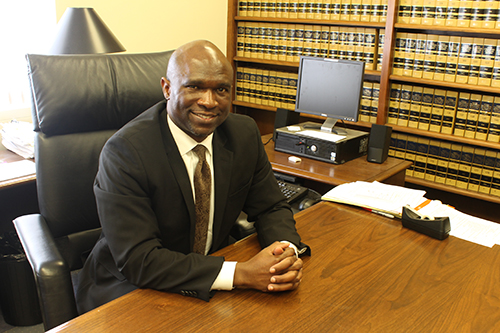
For 15 months, across 13 sessions of a preliminary hearing in a Santa Cruz County murder case, three Spanish-speaking defendants shared a single interpreter.
Writing for the 6th District Court of Appeal in Molina v. Superior Court (2024), Justice Charles E. Wilson II held that the arrangement violated one defendant's state constitutional right to an interpreter. He ordered the charges dismissed, while leaving prosecutors free to refile.
"A defendant unable to communicate with counsel during such testimony is relegated to the role of a spectator in his own criminal case," Wilson wrote. The trial court had called a separate interpreter for each defendant "best practices." Wilson responded that "it is a constitutional right."
Wilson, a justice of the 6th District since his nomination by Gov. Gavin Newsom in 2021, faces voters Nov. 3 for a full 12-year term.
His opinions have also addressed when established rules should give way to changing circumstances.
In Camp v. Home Depot U.S.A. Inc. (2022), the court revived a worker's claim that rounding his time to the nearest quarter hour had cost him about 7.8 hours of pay over five years. Wilson concurred but wrote separately "to explain why I believe the majority's decision today is a clear departure from See's Candy," a 2012 appellate decision. When an electronic system captures every minute worked, he concluded, rounding that underpays an employee is unlawful under California's "strong public policy favoring timely payment of wages for all hours worked."
The panel invited the state Supreme Court to settle the question, and the high court granted review in February 2023 but has yet to hear argument. Until it rules, trial courts may cite the 6th District's decision as persuasive authority.
Wilson has taken a more restrained view of judicial authority in disputes involving government.
He rejected property tax refund claims by AT&T, Sprint and T-Mobile in County of Santa Clara v. Superior Court (2023). The companies argued the state Constitution required their utility property to be taxed at the same rate as other property. "The remedy for such disparate treatment, however, lies with the Legislature," he wrote.
A year later, Wilson dissented when the court ordered a trial judge to invalidate Measure D, Palo Alto's voter-approved repeal of binding arbitration for police and firefighter contract disputes because the city had failed to consult the union. Wilson would have upheld the trial judge's narrower remedy. "Otherwise, the majority's decision today risks replacing the trial court's discretion with its own," he wrote.
Beyond his opinions, Wilson has made mentoring future lawyers and judges a focus. "Mentoring students, lawyers, and judges is something that I find to be very rewarding," Wilson said in emailed comments.
He co-chairs the California Judicial Mentor Program-Appellate which helps lawyers understand the judicial selection process and has expanded to include appellate research attorneys.
Wilson and his colleagues also formalized and expanded the court's summer externship program. From 2022 through 2026, 38 law students from across the country completed it.
"I believe it is critically important that we open our doors to the next generation of lawyers so that they can consider a future serving the public in our courts," Wilson said.
He traces that commitment to a mentor of his own: Martin J. Jenkins, a fellow University of San Francisco alumnus who, as a federal judge, encouraged Wilson to clerk with the Alameda County district attorney's office. He was later a prosecutor for seven years before Gov. Jerry Brown appointed him to the Santa Clara County Superior Court.
Wilson, who grew up in East Palo Alto, told the Daily Journal in 2015, "Growing up where I did, I had some concerns about my desire to go into criminal law. ... I realized to make a difference, to make the type of difference that I wanted to make, I thought it would be helpful for someone like me to be on that side of the table."
Laurinda Keys
laurinda_keys@dailyjournal.com
For reprint rights or to order a copy of your photo:
Email
Jeremy_Ellis@dailyjournal.com
for prices.
Direct dial: 213-229-5424
Send a letter to the editor:
Email: letters@dailyjournal.com