


Ethics/Professional Responsibility
Oct. 15, 2026
Why formality still matters in the age of remote proceedings
As remote court appearances become more casual, the traditions that reinforce respect for the judicial process and public confidence in the courts risk being lost.



Hall of Justice
Ronda J. McKaig
Supervising Civil Judge
Ventura County Superior Court
Civil Trials, Law & Motion
Loyola Law School
In colonial America, courtrooms were solemn spaces, steeped in pomp and circumstance and certain British traditions such as barristers garbed in powdered wigs and gowns.
Since the American Revolution, the pomp and circumstance dissipated, but courtrooms remained formal environments, governed by well-established rules of etiquette and procedure. Attorneys showed respect for the court and its staff by adhering to protocols such as avoiding the well and standing to address the court. It was unheard of for an attorney to appear in anything other than business attire, and the bench insisted on it. In our lifetime, "Button your jacket, counsel!" was uttered by more than one judge when a slightly disheveled lawyer appeared in court.
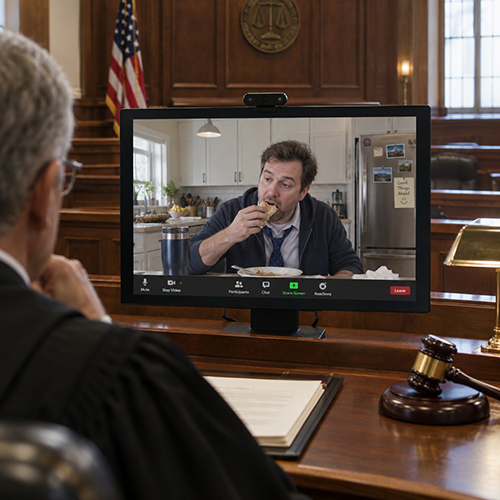
Today, it is commonplace to appear in court through a screen. The ability to appear remotely has revolutionized access to justice and improved efficiency, and that is a very good thing. But the convenience of remote appearances has brought with it a gradual erosion of courtroom formality, and a new casual approach to court proceedings has emerged. The informality may seem harmless. It isn't.
Think about the last time you were in a courtroom. The physical attributes of the courtroom do a remarkable amount of work for the judicial system without anyone having to explain them. The bench is elevated. The judge wears a robe. Lawyers dress professionally and stand when addressing the court. There are prescribed forms of address. There are rules about where people sit and how they conduct themselves.
Those physical attributes and time-honored traditions communicate that the courtroom is different from other places where business is conducted. The courtroom is a place where disputes are resolved, rights are determined and decisions are made that profoundly affect people's lives. It is a place that commands--and deserves--respect.
As courts have transitioned to remote appearances, the physical architecture of the courtroom disappears and, too often, its traditions disappear with it. There are too many litigants--parties and attorneys alike--who make appearances from cars, bedrooms, kitchen tables and even the occasional bathroom. An attorney who wears a business suit in court without fail will appear remotely in a polo shirt and baseball cap, or a T-shirt and sweater. Counsel who give the court their full attention when physically present will tend to other chores while appearing remotely, often without muting themselves, treating the court to their separate conversations and background noise.
Those of us who have ventured onto the thin ice of pointing out the impropriety of such conduct have been met with puzzled looks, a sheepish "sorry," or the excuse that the attorney was asked to cover at the last moment, such that the situation could not be avoided. And while it may be tempting to dismiss these as minor lapses in etiquette, they point to something worth discussing.
Why courtroom formality matters
A remote appearance is still an appearance before the court.
That may seem obvious, but technology can make it remarkably easy to forget. A Zoom or Teams hearing can look much like a business meeting or a FaceTime call. But what is happening on the other side of that screen is fundamentally different.
A courtroom is not simply a room. It is an institution.
The formalities of the courtroom--how we dress, how we address one another, when we speak, where we sit and how we conduct ourselves--are not empty ceremony. They serve an important purpose.
Court proceedings often involve matters of enormous consequence. A person's liberty, family, livelihood, property, reputation or financial future may be at stake. The formality of the proceeding communicates that these matters deserve our attention and respect.
Courtroom formality also helps establish the authority and legitimacy of the judicial process. The court's authority does not rest merely on its power to issue orders. It rests, in substantial part, on the public's understanding and belief that the courtroom is a place of dignity and neutrality, where disputes are resolved according to law through a fair and orderly process.
The rituals of the courtroom help create that environment.
When we stand when the judge enters, wait to be recognized before speaking, refrain from interrupting and appear in appropriate attire, we are participating in a common language of respect. We are signaling that the proceeding is different from an ordinary conversation and that the institution--and the people who have come before it--deserve our full attention.
The formalities remind us of our roles
The formalities of the courtroom also remind us who we are and what we are there to do.
The lawyer is not simply a participant in a meeting. Counsel is appearing as an advocate and as an officer of the court. The judge is not simply another person on a video call. The parties are not merely customers or clients. Each person has a defined role in a process that exists to resolve disputes according to law.
Those distinctions matter because the justice system depends upon everyone understanding and fulfilling their role.
Our conduct in court reflects our respect for the judiciary and the traditions that connect the past to the present
Our treatment of a remote court appearance should not depend upon our individual comfort or convenience, our level of experience or our mood. Remote technology changes how we enter the courtroom. It should not change how we conduct ourselves.
When we preserve the traditions and dignity of the court, we maintain a place in which the seriousness of the proceedings is evident, the integrity of the institution is respected and the public can have confidence that its courts are worthy of its trust. Without this trust, the system cannot function.
As you prepare for your next remote appearance
None of the formalities, standing alone, may seem particularly consequential. So an attorney is not wearing a jacket, or we can hear a dog barking in the background. Why should we care?
We should care because institutions are shaped by the small things they permit, tolerate and eventually accept as normal. Left unchecked, the nonchalance with which we treat remote appearances will eventually undermine the very justice we all seek. To the court users who are already committed to maintaining courtroom formalities - thank you. To those who are not so committed, now is the time to embrace the formal traditions of the courts and bring the same preparation, courtesy, professionalism and appropriate attire to a remote appearance that they would bring to the physical courtroom. The legal profession and our system of justice deserve nothing less.
Submit your own column for publication to Diana Bosetti
For reprint rights or to order a copy of your photo:
Email
Jeremy_Ellis@dailyjournal.com
for prices.
Direct dial: 213-229-5424
Send a letter to the editor:
Email: letters@dailyjournal.com