


U.S. Supreme Court,
Environmental & Energy
Oct. 19, 2026
Climate change on trial: Can oil companies escape state court?
Federal law does not preempt state tort suits against energy companies for their role in climate change. Yet Supreme Court oral arguments left considerable doubt about whether those suits will proceed.


Erwin Chemerinsky
Dean and Jesse H. Choper Distinguished Professor of Law
UC Berkeley School of Law
Erwin's most recent book is "Worse Than Nothing: The Dangerous Fallacy of Originalism." He is also the author of "Closing the Courthouse," (Yale University Press 2017).
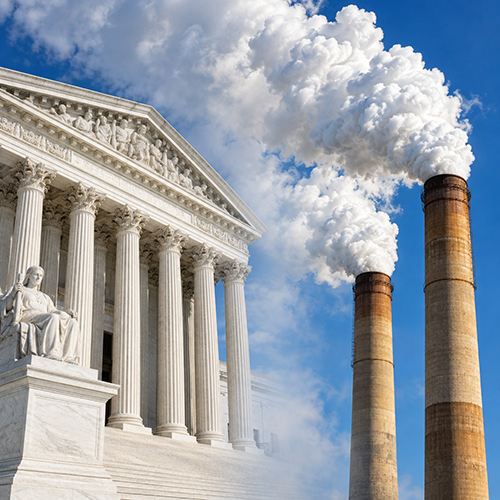
As a matter of law, it should be an easy question for the Supreme Court: federal law does not preempt the ability to sue energy companies for their role in causing climate change. But oral arguments on Monday, Oct. 5, in Suncor Energy, Inc. v. County Commissioners of Boulder County left considerable doubt as to how the Court will rule.
The plaintiffs, the County Commissioners of Boulder County and the City of Boulder, sued Exxon Mobil Corporation and three Suncor Energy entities in Colorado state court, seeking damages for the role that the companies' production, promotion, refining, marketing and sale of fossil fuels allegedly played in exacerbating climate change and thereby harming Boulder's property and residents. Boulder brought claims for public nuisance, private nuisance, trespass, unjust enrichment and civil conspiracy, alleging that the companies knowingly contributed to climate change while misleading the public about the dangers of their products. Boulder further alleges that it has incurred and will incur millions of dollars in costs to protect against climate impacts such as wildfires, flooding and drought. Boulder does not seek to enjoin any oil and gas operations or sales, and it does not seek to enforce emissions controls of any kind.
The Colorado Supreme Court ruled that Boulder's claims are not preempted by federal law and remanded the case for trial, expressing no opinion on the ultimate viability of the merits.
This is one of many civil cases brought against major oil companies for their role in contributing to climate change. It is the first to make it to the Supreme Court. The issue is whether state tort liability is preempted by federal law.
Preemption is based on the supremacy clause of Article VI of the Constitution, which provides that the Constitution, and laws and treaties made pursuant to it, is the supreme law of the land. If there is a conflict between federal and state law, the federal law controls and the state law is invalidated because federal law is supreme.
Traditionally, the Supreme Court has identified two major situations where preemption occurs. One is when federal law expressly preempts state or local law. The other is where preemption is implied by a clear congressional intent to preempt state or local law. There are three types of implied preemption: conflicts preemption, where the federal and state laws are mutually exclusive; objectives preemption, where the state or local law interferes with achieving a federal objective; and field preemption, where Congress has evidenced a clear intent to have federal law wholly occupy the field.
But under these principles, there is no preemption in Suncor Energy. There is no provision in the Clean Air Act or any other statute that explicitly preempts state regulation or state tort liability.
As to implied preemption, there is no conflict between federal law and state law; there is no reason that both could not be followed. In fact, as the Colorado Supreme Court observed, the Clean Air Act preserves states' authority to regulate air quality. Nor is there any basis for concluding that Congress meant for there to be field preemption.
Perhaps the argument is that allowing states to regulate greenhouse gas emissions is inconsistent with the objectives of federal law. But as the respondent, City of Boulder, argues in its brief, the EPA has recently denied that it has the authority to regulate greenhouse gas emissions. The respondent says: "It does not explain how the Court can hold that the Clean Air Act preempts claims indirectly relating to greenhouse-gas emissions when EPA maintains that the Act does not allow it to directly regulate some (perhaps any) greenhouse-gas emissions."
Thus, this is a preemption case that does not fit into the categories of preemption that the Court has long articulated. The energy companies make three primary arguments for finding preemption. First, they argue that the Constitution denies to the states the ability to regulate pollution because of its interstate nature. Petitioners write: "Instead, the structure of our constitutional system continues to foreclose resort to state law unless Congress affirmatively authorizes its application. States have no residual or inherent power under our Constitution to regulate in this area, and no federal law authorizes state common-law claims for harms caused by diffuse interstate and international emissions."
This is a stunning claim because the Tenth Amendment always has been understood to allow states to do anything that is not forbidden by the Constitution. If the Court accepts this argument, the implications could be enormous in denying states the ability to regulate activity with interstate effects. This could conceivably be taken to preempt any state environmental laws. The petitioners point to Supreme Court cases creating federal common law in this area and say that the "Court has long held that interstate pollution is an inherently federal area in which state law cannot govern." But the fact that federal law, even federal common law, exists doesn't answer the question of whether there is preemption of state law. At the oral arguments, Justice Brett Kavanaugh seemed to embrace this view, while Chief Justice John Roberts clearly saw the vast implications of accepting it.
Second, the petitioners argue that the Clean Air Act preempts state tort liability. But the Act explicitly says that it does not preempt state regulation to protect the environment.
Finally, the petitioners argue that inevitably there would be foreign policy effects to allowing state tort liability and it therefore should be deemed preempted on that basis. The petitioners write: "Respondents' claims fail for the additional reason that, by seeking redress for the effects of international emissions, they infringe on the federal government's exclusive authority over foreign affairs." But accepting preemption here would be a substantial expansion of this doctrine. If the Court accepts the argument here, that would seemingly limit states' ability to create tort liability whenever there are international consequences, including cases involving a multinational corporation.
As a matter of preemption law, it should be clear that the Colorado tort suit is not preempted. But at oral arguments, several justices, including Justice Elena Kagan, expressed great concern over opening the door to such suits and that many cities could copy Boulder's legal action. If that is a problem, it should be addressed by Congress. Nothing in the Constitution or any federal law allows the Supreme Court on its own to close the courthouse doors.
It is possible the Court won't reach the preemption question. There is a serious issue as to whether the Supreme Court has jurisdiction because there is no final judgment from the Colorado courts. The case was remanded for a trial, and the Supreme Court generally hears a case only when there is a final judgment.
Also, Justice Samuel Alito recused himself from participating. The Court could split 4-4, which would mean that the Colorado Supreme Court decision is affirmed by an evenly divided Court and the matter would go back to the state trial court.
The Roberts Court is staunchly pro-business and politically conservative, while many conservatives remain deeply skeptical of climate change. Yet the law is clear: federal law does not preempt suits against energy companies over their role in causing climate change.
Submit your own column for publication to Diana Bosetti
For reprint rights or to order a copy of your photo:
Email
Jeremy_Ellis@dailyjournal.com
for prices.
Direct dial: 213-229-5424
Send a letter to the editor:
Email: letters@dailyjournal.com