


Environmental & Energy
Oct. 19, 2026
The Forest Service Roadless Rule, revisited
What 17 states' opposition to the rule's proposed rescission signals for the road ahead.




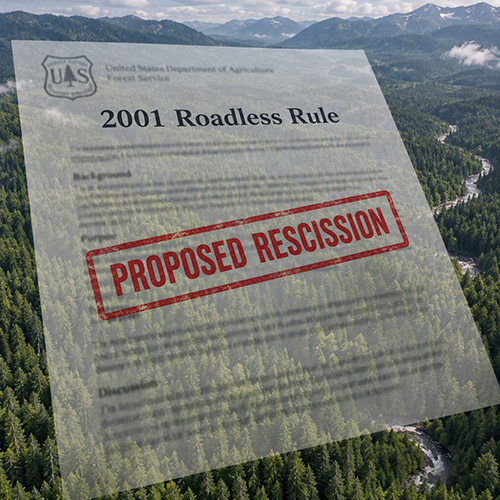
For a quarter-century, the 2001 Clinton-era Roadless Area Conservation Rule (Roadless Rule) has largely kept roads, commercial logging and other development out of approximately one-third of the National Forest System lands managed by the United States Department of Agriculture, Forest Service (Forest Service). 66 Fed. Reg. 3244 (Jan. 12, 2001). In this 25-year period, the Roadless Rule, amendments thereto, and projects planned for implementation within areas governed by the Roadless Rule have been the subject of repeated litigation. On Aug. 20, 2026, the Forest Service proposed rescinding the rule entirely. 91 Fed. Reg. 53,827 (Aug. 20, 2026). Over 370,000 comments were submitted during the public comment period.
On Oct. 6, 17 state attorneys general, led by California, Oregon and Washington, filed 72 pages of detailed comments opposing the proposal on the basis that it would open nearly 45 million acres to new roadbuilding, timber harvest, mining and oil and gas development (State Comment). Their letter reads like a draft complaint, and it seems clear that litigation is likely soon to follow any final action by the Forest Service.
The Forest Service's Roadless rescission rationale
The Forest Service's rescission proposal cites an intent to reduce regulatory burdens, enhance flexibility to respond to changing local resource conditions and return decision-making for management of roadless areas to individual national forests. Forest management decisions would be governed by forest plans adopted pursuant to the Forest and Rangeland Renewable Resources Planning Act of 1974, as amended by the National Forest Management Act of 1976 (NFMA). 91 Fed. Reg. 53,827 (Aug. 20, 2026).
The states' case
The State Comment advances three principal arguments. First, it argues that the proposed rescission violates NFMA. Many forest plans, especially those revised under the Forest Service's 2012 Planning Rule, adopted the Roadless Rule's prohibitions as binding standards. The states contend those standards cannot be removed or modified without formal forest plan amendments. They add that new roads are inconsistent with NFMA's requirement of an economical and environmentally sound transportation system, given a Forest Service road maintenance backlog that was estimated at $8.4 billion in 2001 and has since grown.
Second, the State Comment argues that the proposed rescission violates the Administrative Procedure Act (APA), primarily on the basis that the Forest Service has not provided a reasoned explanation for its reversal. Specifically, the State Comment argues that the change in policy lacks support, given the Forest Service's original justification for the Roadless Rule that local management resulted in piecemeal protections to roadless areas. Additionally, the State Comment argues that the Forest Service has not explained or adequately considered fiscal and staffing limitations that prevent the Forest Service from meeting maintenance demands, the connection between increased wildfire management and the proposed rescission, or the legitimate reliance interests of the states on federal management of roadless areas to protect ecological services, recreation and conservation benefits.
Third, the State Comment raises a variety of National Environmental Policy Act (NEPA) claims. These include that the Forest Service's NEPA analysis employs an unreasonably narrow purpose, fails to analyze a reasonable range of alternatives, includes inadequate mitigation measures, and failed to consider indirect and cumulative effects. The State Comment also takes broad aim at the Forest Service's reliance on the Department of Agriculture's 2025 NEPA regulations at 7 CFR Part 1b, arguing those regulations were promulgated through a deficient interim final rule process, are substantively deficient, and therefore invalidate the NEPA process undertaken in support of the proposed rule.
Counterpoints in support
The thesis advanced in the State Comments, however, is not the only perspective. Supporters of the Forest Service's proposal may argue, for example, that conditions have changed in the 25 years since the Roadless Rule was promulgated, and that additional management flexibility is needed to address wildfire, drought, insects and disease. In other words, a roadless forest does not necessarily mean a healthy or fire-resilient forest. Furthermore, the proposed rescission does not automatically authorize additional road construction or timber harvest, which is still subject to Forest Service approval through applicable federal laws and existing forest plans.
Looking down the road
If the Forest Service's rescission proposal is finalized and adopted, a legal challenge appears sure to follow. The State Comment letter provides a clear roadmap of potential legal claims. The arguments under the APA--in particular, those relating to sufficiency of justification for changing agency positions--have a basis in cases such as Organized Village of Kake v. U.S. Department of Agriculture, 795 F.3d 956 (9th Cir. 2015), a case cited throughout the State Comment, and FCC v. Fox Television Stations, Inc., 556 U.S. 502 (2009), under which the key inquiry will be whether the Forest Service provided a reasoned explanation to reconcile its rescission proposal with its original 2001 findings. To the extent the Forest Service carries its burden, the deferential "arbitrary and capricious" standard of review under the APA may be hard for plaintiffs to overcome, especially given that courts are generally disinclined to second-guess agency policy decisions. Similarly, after Seven County Infrastructure Coalition v. Eagle County, 605 U.S. 168 (2025), any NEPA claims likely face an uphill battle given the Supreme Court's strong message of deference to the agency and narrowed scope of review. There is less appellate precedent directly informing the states' expansive NFMA theories, however, so litigation there may tread new ground.
The practical consequences of the Roadless Rule rescission proposal, and any resulting litigation, will reach well beyond the courtroom. The Forest Service's proposal, in furtherance of executive orders directing expanded timber and energy production, would open approximately 4.8 million operable acres to timber harvest. But additional permitting for those activities would first be needed and may draw its own legal challenges that could keep forest managers' hands tied from implementing the additional management flexibility, forest health improvements and wildfire risk reduction cited by the Forest Service in support of the proposed rescission.
The road, it seems, will be long and winding.
Submit your own column for publication to Diana Bosetti
For reprint rights or to order a copy of your photo:
Email
Jeremy_Ellis@dailyjournal.com
for prices.
Direct dial: 213-229-5424
Send a letter to the editor:
Email: letters@dailyjournal.com