


Oct. 21, 2026
Danner's opinions shape high court decisions as she trains new justices
Justice Allison Danner, who trains new appellate justices, and whose rulings the state Supreme Court has drawn on or upheld in cases on police searches, murder resentencing and pension bonds. She seeks retention Nov. 3.


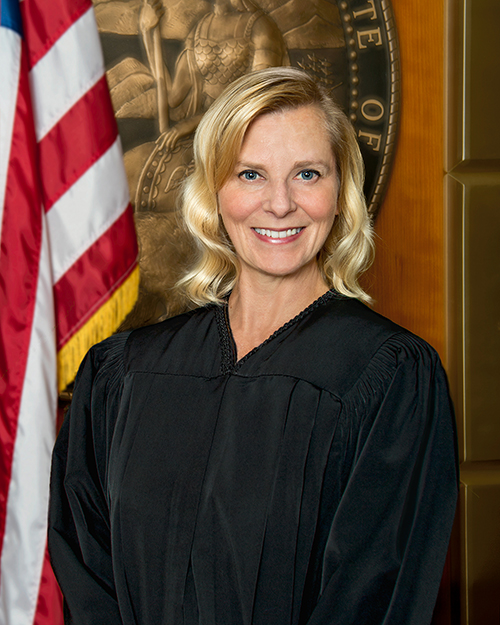
Justice Allison M. Danner trains California's newest appellate justices, and her own opinions have helped shape decisions by the state Supreme Court.
The high court has drawn on her reasoning or upheld her results in three cases involving police searches, murder resentencing and a city's $3.5 billion pension bond plan.
Danner, appointed to the 6th District Court of Appeal by Gov. Jerry Brown in 2018, chairs mandatory training seminars for new justices and the Judicial Council's Appellate Advisory Committee, which recommends rules of practice. She has written more than 450 opinions and seeks a full 12-year term Nov. 3.
The clearest example is People v. McWilliams, an unpublished 2021 decision in which Danner dissented in part from a ruling allowing evidence obtained after an unlawful detention.
A San Jose officer investigating suspicious activity around parked cars ordered Duvanh Anthony McWilliams out of a vehicle. Learning that McWilliams was on parole and subject to suspicionless searches, the officer searched him and the car, finding a gun and drugs.
Danner agreed that the detention was unlawful but disagreed that the evidence was admissible anyway. The parole condition gave the officer discretion to search, she wrote, not an obligation. She also warned of a "growing recognition that seemingly small constitutional violations can add up to problems of significant national dimensions."
The Supreme Court reversed in People v. McWilliams (2023), reaching the same conclusion on the officer's discretion and quoting her warning.
The Supreme Court also relied on Danner's reasoning in a murder resentencing case, though it rejected part of her unanimous panel's approach.
In People v. Drayton (2020), she wrote that judges reviewing petitions under Senate Bill 1437, which narrowed felony-murder liability, must accept petitioners' factual assertions as true rather than weigh evidence before holding a hearing.
The Supreme Court quoted Drayton three times in setting those limits in People v. Lewis (2021), but rejected the two-step review framework Drayton had followed.
In a third case, the Supreme Court upheld Danner's result but used different reasoning.
She wrote City of San José v. Howard Jarvis Taxpayers Assn. (2024), upholding the city's plan to issue up to $3.5 billion in pension obligation bonds without a two-thirds vote. Refinancing existing pension obligations did not create new debt, she reasoned. "The city undoubtedly must pay these pension obligations."
The Supreme Court affirmed in 2025, holding that the bonds fell within an exception to the debt limit for obligations imposed by law.
In People v. Howard (2024), she applied the California Racial Justice Act of 2020, which covers implicit as well as intentional bias. Jermaine Randy Howard, who is Black, was convicted of second degree murder after a prosecutor questioned him on cross-examination about his ties to East Palo Alto.
Danner found the questioning relevant and facially race-neutral but wrote that "we cannot under the RJA end our inquiry there." Given the city's history and demographics, she concluded Howard was entitled to an evidentiary hearing without deciding whether the act had been violated.
Danner's path to the appellate bench took her through academia, federal prosecution and a trial court. The Stanford Law School graduate became a tenured professor at Vanderbilt University Law School, where she taught from 2001 to 2007. She also taught at Harvard, UCLA and Stanford law schools. Her specialty was United Nations criminal tribunals. "I basically taught myself the field," she said.
Wanting to be "more in the real world," she joined the U.S. attorney's office for the Northern District of California in 2007, and spent five years there, including a year's leave as an attorney-adviser on national security issues in the Justice Department's Office of Legal Counsel.
Brown appointed her to the Santa Clara County Superior Court in 2012, though she had no state court experience. "I hadn't even been in the building until my first day of work," she said.
Laurinda Keys
laurinda_keys@dailyjournal.com
For reprint rights or to order a copy of your photo:
Email
Jeremy_Ellis@dailyjournal.com
for prices.
Direct dial: 213-229-5424
Send a letter to the editor:
Email: letters@dailyjournal.com