


Criminal
Oct. 26, 2026
Gov. Newsom's commutation options
Gov. Gavin Newsom has three options for California's condemned inmates: do nothing, commute roughly half or attempt to commute them all. Each carries political and legal complications.


David A. Carrillo
Executive Director
California Constitution Center at Berkeley Law.
Email: carrillo@law.berkeley.edu

Brandon V. Stracener
Attorney in private practice and a Senior Research Fellow
Berkeley Law's California Constitution Center
We speculate that whatever decision California Gov. Gavin Newsom might make about the state's condemned inmates will happen soon, but not before the Nov. 3 election. This article details the various factors that can weigh on his thoughts. Let's first stipulate that every condemned inmate was convicted of awful crimes and that those convictions and death judgments have been affirmed on appeal. Let's also stipulate that we're not discussing guilt or innocence, the flaws in the criminal justice process, or whether the death penalty is or should be the law.
The question here instead is whether and how to exercise the commutation power. We see three primary paths: do nothing, commute half or try to commute them all. On every path the governor is beset on all sides. We would swing for the fences and commute them all.
Do nothing. The simplest path is to balance the competing imperatives by saying they cancel each other. The governor tells the anti-capital-punishment advocates that he has done enough for them with the execution moratorium. Xavier Becerra has committed to maintaining that policy, so assuming he wins the governor race, that side should be satisfied with a combined 24 years of lives saved. The governor tells the victim and law enforcement advocates that although he never signed a death warrant, neither did he impair anyone's ability to pressure the next governor to restart executions. On future campaign trails, the governor can paint this as a good compromise because it gave all stakeholders something while making everyone unhappy.
Commute half. On his own writ, the governor can commute the death sentences of inmates who have only one felony conviction, or about half the current condemned population. In 2019 the Los Angeles Times reported that there were 737 total condemned inmates, and at the time, less than half had just one felony. The New York Times reports that the condemned number now is 563, and it's still true that around half have just one felony conviction. To commute the single-felony group the governor only needs to sign here: "I hereby commute to life without parole the sentences of those condemned inmates with one felony conviction," and it's done. In future campaigns, this sells as a Solomonic decision that settled the matter with wisdom, balancing duty with mercy.
(Attempt to) commute them all. The governor must secure agreement from four California Supreme Court justices to commute any condemned inmate with two or more felonies. Unlike the first two options, this path is fraught with unknowns, combining the benefit of making it the court's problem with the risk of looking the fool if the court rejects the request.
It's unclear what the California Supreme Court might do. It would have to decide whether a group commutation is an abuse of power (the governor's and the court's), and whether the court's internal guidelines apply in this edge case. Those guidelines ask the court to "determine whether the applicant's claim has sufficient support that an act of executive clemency, should the Governor choose to grant it, would not represent an abuse of that power." If that applies, is it per se an abuse of power to commute several hundred inmates at once? Does it matter if the governor reviewed each file and determined that all were worthy? Will four justices embrace the court's power to endorse hundreds of simultaneous commutations?
And the court has to decide whether it needs to review several hundred applications individually. That creates a time problem: as Chief Justice Cantil-Sakauye noted in 2018, waiting until there are two months left in the governor's term to drop such a complex issue on the court creates enormous time pressure and carries substantial risk that the clock runs out. That provides incentives to reject the group request outright for denying the court time to invoke the option of individual review. Add the fact that the governor still needs to appoint a new justice: does that person need to vote on this furball in their first month on the job? Will the court appoint a pro tem, or would it decide with six? The mind boggles at the variables.
Zoom out for a moment to recognize that California law is established and directed by the state's people; that capital punishment is an option is their choice. When a jury imposes a death sentence, that's also the people's voice. But California's constitution charges the governor with the responsibility for executing the law and vests him with power to commute sentences on whatever conditions he deems proper. Those competing charges impose on a governor the awesome responsibility of making the ultimate choice: to kill or not to kill.
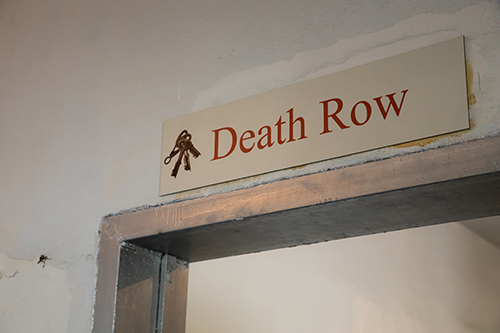
It's time to make a call. No one has been executed in California in over 20 years. In that span, voter support for capital punishment has declined each time it appeared on the ballot. Death Row at San Quentin is empty and its gas chamber has been dismantled. A decade ago, the California Supreme Court rebuffed an attempt (2016 Proposition 66) to expedite capital appeals, without electoral consequences. Gov. Newsom beat a recall and was reelected with his moratorium in place. A governor who (as with same-sex marriage bans) predicts or precipitates capital punishment's end in California could look visionary. This is an opportunity to stand tall and do the right thing, unforeseeable political consequences be damned. Commute them all.
Submit your own column for publication to Diana Bosetti
For reprint rights or to order a copy of your photo:
Email
Jeremy_Ellis@dailyjournal.com
for prices.
Direct dial: 213-229-5424
Send a letter to the editor:
Email: letters@dailyjournal.com