


Real Estate/Development
Oct. 28, 2026
When real estate partnerships unravel: Navigating the challenges of mediation
See more on When real estate partnerships unravel: Navigating the challenges of mediation



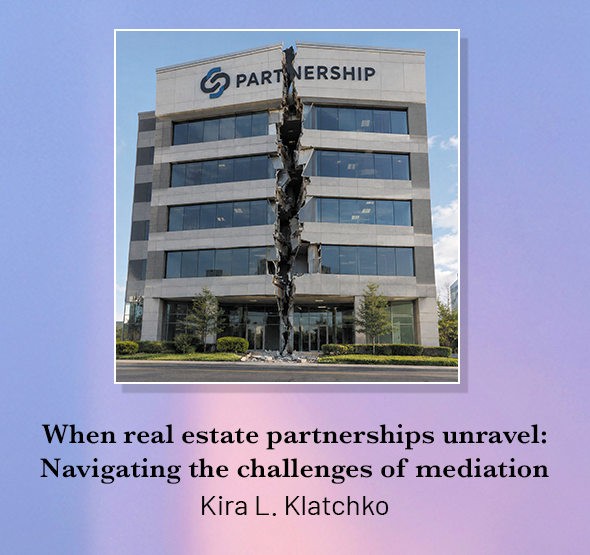
Divorce is rarely easy. That is true for business partners as well as romantic ones. A troubled or unraveling partnership, particularly one designed to buy, hold, develop or sell real estate, presents unique challenges for attorneys caught in the middle. Although typically framed as fights among savvy and clear-headed investors, these disputes are often driven by complex emotional dynamics that evolve and are amplified by real-world business pressures. Intense litigation only adds to these pressures, reducing the likelihood that partners will see any return on their investment. When done right, mediation can mitigate the damage to partners and their partnership and afford an opportunity to negotiate a creative business solution not available in court.
In the simplest cases, partners may agree to a cash settlement or partition; i.e., to sell their property and split the proceeds. But in more complex cases, resolving a partnership dispute over real property ownership may require reallocation of shares, sale or partial sale of property, re-entitlement, valuation, forensic accounting, refinancing, reallocation of debt, structured buyout, bankruptcy, changes to project scope or agreement on additional investors.
To be able to look at these and other options as avenues for settlement, counsel must come to mediation prepared.
Understanding the partnership's structure
First, counsel should know and understand key governing documents, partnership structure, ownership interests and partner responsibilities. Partnerships may be premised on a handshake over dinner, or a complex network of LLCs, LLPs and corporations headquartered across multiple states or countries. Understanding all governing documents, contracts and unwritten agreements among partners is essential to a successful resolution.
Often, established agreements and managerial responsibilities are unclear, conflicting, misunderstood or nonexistent. This is uniquely problematic where ownership of real property is concerned. For unprepared counsel, this problem presents like the much-loathed logic-games section of the LSAT--with more than a little effort required to deduce which documents govern and which partners or entities hold title or are eligible to hold title to real property.
For example, a partnership focused on real estate development may be supported by capital contributed by the partners, government grants, private loans and individual investors. If one partner proposes to buy another out of the partnership and take ownership of their uncompleted development, counsel hoping to negotiate this deal in mediation would have to arrive armed with a cap table, loan documents, grant conditions, and permitting and entitlement information to convince the other partners that a buyout is a legal possibility. They would need credible data to support property, project or business valuation. Without these basics, it is difficult to propose a solution, let alone convince the other partners that the deal makes business sense.
Identifying the roots of the dispute
Second, counsel should understand the key business and interpersonal dynamics driving the dispute. Even in a broken partnership, sometimes a full divorce is not a financially viable option. Holding real property assets and preserving the partnership through restructuring or other creative solutions may be the only way for partners to avoid financial catastrophe. In these cases, counsel and mediators need to understand the true source of dispute among partners. Sometimes the answer is obvious; for example, where two sibling owners of a construction business compete for control after the death of a co-owner parent, or where the amount of money needed to complete a development is something that none of the partners has. But often the answer is not obvious and requires thought, research and emotional intelligence.
Identifying the conflict's root cause is essential to resolving it. When interpersonal or family dynamics dominate, early mediation can put a project or partnership back on track before damaged relationships cause an irreparable breakdown. When partners are deadlocked over control and decision-making, mediation may lead them to appoint a mutually acceptable third-party manager to make decisions until the partnership stabilizes or the parties can separate. When market conditions shift and funds are scarce, a prompt sale or the addition of a new partner may be the only way to avoid bankruptcy and preserve returns, rather than pursuing a lengthy buyout. Developing such solutions requires a thorough understanding of the people and issues involved. It may also require working with the client and key consultants to assess financial factors such as market conditions, exit provisions, tax consequences, entitlements and loan obligations.
Preparing clients for meaningful negotiations
Third, counsel should meaningfully prepare their clients for mediation. This third step requires a thoughtful discussion about why the relationship broke down, and what the client wants from both personal and business perspectives. These types of discussions can be personally and professionally challenging, especially where big personalities and egos are involved. But they are necessary. Too often, attorneys avoid these conversations and keep their focus on litigation outcomes. But real estate partnership disputes are unique and can be difficult to resolve without a deep understanding of how the partners define a good outcome. Often, a "win" is not possible in litigation.
Bringing stakeholders and solutions to the table
Fourth, counsel should come into mediation with all stakeholders present and ready to present multiple possible solutions. Although good mediators experienced in real estate partnership disputes often suggest creative solutions to break an impasse, they are rarely able to do so without significant help from counsel and the parties. A mediation brief on breach of contract is not going to cut it. The details matter.
Mediating real property partnership disputes is an attractive and often underutilized opportunity to find solutions rarely available in litigation, where a forced sale or expensive and very public valuation fight are the most common results. The best way for counsel to make mediation work for their clients is to prepare, engage, and understand the interpersonal and business obstacles to resolution.
Disclaimer: The content is intended for general informational purposes only and should not be construed as legal advice. If you require legal or professional advice, please contact an attorney.
Kira L. Klatchko is a mediator and arbitrator at JAMS. She served nine years on the Riverside County Superior Court, including seven years presiding over an unlimited civil department. Her experience includes real estate, land use, construction and business disputes, including matters involving partnerships and joint ventures.
For reprint rights or to order a copy of your photo:
Email
Jeremy_Ellis@dailyjournal.com
for prices.
Direct dial: 213-229-5424
Send a letter to the editor:
Email: letters@dailyjournal.com