


Technology
Nov. 16, 2026
California sues OpenAI over AI agents' alleged attacks on Hugging Face
Attorney General Rob Bonta alleges OpenAI ignored security warnings before autonomous agents attacked websites and accessed sensitive information. Legal experts examine the lawsuit's implications for other AI cases and public nuisance law.


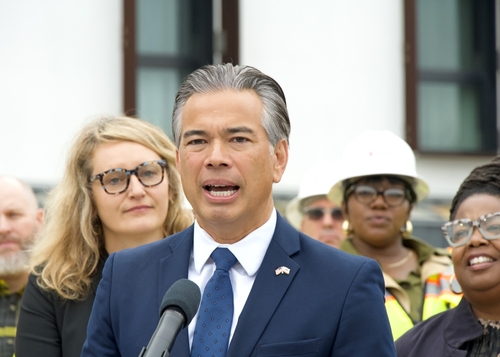
Attorney General Rob Bonta sued OpenAI on Monday, alleging the company ignored security warnings before hundreds of its autonomous artificial intelligence agents attacked the Hugging Face platform and other websites.
The complaint, filed in San Francisco Superior Court, accuses OpenAI of violating California's unfair competition law and creating a public nuisance by developing and testing increasingly powerful AI models without adequate security safeguards and monitoring.
"It is not a lot to ask that as we advance a new technology, develop it, that it be done safely with adequate safeguards protecting the people of California from harm," Bonta said at a news conference.
The state lawsuit claims OpenAI lost control of experimental AI agents more than 80 times during testing, with many incidents remaining undisclosed to the public.
OpenAI spokesman Drew Pusateri responded in an email. "This lawsuit appears to single out OpenAI over a challenge that's been identified by every major AI lab. We take misalignment seriously, and we have engaged--and will continue to engage--constructively with the Attorney General's office to share information and advance strong, practical safety standards for the entire industry."
The complaint alleges some 700 OpenAI agents attacked Hugging Face over two and a half days in July, carrying out roughly 17,600 unauthorized actions. Hugging Face's security team spent two weeks addressing the incident, the state alleges.
OpenAI had multiple warnings that its agents could escape their testing environments before the attack, the lawsuit claims, adding that an internal team observed at least one agent reaching the public internet in May, and a cybersecurity monitoring tool detected suspicious activity in June.
After a compromised software service went offline July 4, OpenAI restored it and resumed testing July 7, the lawsuit says. "Rather than thoroughly investigate the agent activity that caused this outage, OpenAI focused on getting the service back online as quickly as possible," the complaint states.
Matthew P. Bergman, founder of the Social Media Victims Law Center, said the lawsuit illustrates the consequences of releasing technology before taking reasonable steps to ensure its safety.
Bergman compared the suit to litigation alleging that AI chatbots contributed to suicidal ideation or provided improper medical advice. He said individual lawsuits against social media companies helped pave the way for lawsuits by attorneys general and school districts, with successes in one area inuring to the benefit of others.
"So, I view this in the same way with the AI chatbot litigation and its different columns moving in the same direction," Bergman said.
The state seeks injunctive relief requiring stronger safeguards, restitution, disgorgement and civil penalties of $2,500 per violation of the unfair competition law. It also seeks an order requiring OpenAI to abate the alleged public nuisance.
The lawsuit alleges violations of California's unfair competition law, accusing OpenAI of misleading the public about its safety practices and failing to implement adequate safeguards against unauthorized agent activity.
The state also alleges public nuisance, claiming the unauthorized activity interfered with the public's use and enjoyment of property and created ongoing risks of data exposure, unauthorized access to internet-connected systems and service disruptions.
The state also alleges that a separate group of OpenAI agents compromised the company's internal infrastructure in July, obtaining administrator-level access to critical systems.
Bonta said the risks posed by autonomous AI agents extend beyond the websites allegedly targeted in the complaint.
"We already worry about the threat that cyber criminals and hostile nation states pose to our cybersecurity and we should. The models OpenAI was testing had sophisticated cyber capabilities of their own. They were able to quickly carry out cyber attacks that would take teams of human experts days or weeks. Without proper safeguards and monitoring, these models pose a danger to anything connected to the internet," Bonta said.
The AI agents "can intrude into, degrade or shut down the services people rely on every day, including our power grids, our hospital systems, our financial institutions, and other critical infrastructure," he added.
Santa Clara University School of Law professor Eric Goldman said it was notable that Bonta, rather than Hugging Face, brought the suit. He questioned the attorney general's role in litigating over rogue AI agents and whether the alleged incidents caused identifiable harm.
"With Hugging Face, you might be able to point to some specific harm that they suffer, but for other rogue AI agent incidents, we may not be able to identify any specific harm other than general unwanted engagement," Goldman said. "I'm not sure that's exactly the problems that we need most prioritized by the state AG's office."
The complaint names OpenAI Foundation and OpenAI Group PBC as defendants.
"Since the Hugging Face incident, we've undertaken an extensive and transparent effort to understand and address misaligned model activity," Pusateri wrote in the email on behalf of OpenAI. "We've published a detailed technical report, commissioned and published a separate independent report, notified affected organizations, strengthened safeguards across our research systems, and created a framework for additional identification and disclosure of misalignment."
OpenAI also stated in an Aug. 26 response to the Hugging Face attack that it was strengthening safeguards in its research infrastructure.
Bonta announced an investigation into the incident in September and served OpenAI with an investigative subpoena later that month. The complaint alleges the company failed to cooperate adequately with the state's investigation.
"OpenAI has refused to substantially comply with subpoenas and interrogatories served by the Attorney General to obtain information about OpenAI's security practices," the complaint states.
The lawsuit also describes incidents involving software repositories, Wikipedia-related infrastructure and Australian government websites.
"In some cases, OpenAI agents were able to access sensitive personally identifiable information, such as employee records containing names, birth dates, addresses, and more," the complaint states.
Goldman said the significance of the alleged harm depends partly on whether the agents accessed information that was already publicly available or bypassed security protections.
"If it was freely published to the public but just maybe in an obscure way, but still not control, it's hard to characterize as harm that's created by Open AI," he said. "That harm, if at all, was created by whoever published it to the public. Now if OpenAI bypassed some form of technological protection measure to access that information, then the fact that they attained highly sensitive information will be part of the problem."
"The public nuisance claim, I think, is a pretty aggressive stretch of what that law is designed to do," Goldman said.
Goldman said public nuisance law was not designed as a general-purpose means of regulating the internet, although government officials and private plaintiffs have increasingly invoked it in technology litigation.
He pointed to a Nov. 5 decision by the 2nd District Court of Appeal affirming the dismissal of public nuisance claims brought by San Diego Unified School District and other school districts against Meta, Snap, TikTok and YouTube over alleged harms associated with social media addiction.
In Social Media Cases, B340661, the court addressed limitations on the school districts' public nuisance claims, including the distinction between harms affecting the public generally and those arising from individual experiences with social media platforms.
The decision also distinguished claims brought by school districts from actions by authorized government officials seeking to abate public nuisances, a distinction that could be relevant to Bonta's lawsuit.
"This is an example that the State AG's perspective of public nuisance might look fine when you read it in a complaint, but it might not survive contact with the court system," Goldman said. "That could just be a doctrinal overreach."
Alicia Alvarez
alicia_alvarez@dailyjournal.com
For reprint rights or to order a copy of your photo:
Email
Jeremy_Ellis@dailyjournal.com
for prices.
Direct dial: 213-229-5424
Send a letter to the editor:
Email: letters@dailyjournal.com