


Alternative Dispute Resolution
Nov. 20, 2026
Mediating anger and conflict with barbecue and a bed-in
Successful mediation requires patience, trust and time for emotions to cool, allowing parties to move beyond anger and conflict toward meaningful resolution.


My aeronautical engineer son likes the story of the Irish mathematician Sir William Rowan Hamilton, who reputedly conceived the theory of quaternions while walking along the Royal Canal near Dublin with his wife in 1843. Not wanting to lose the benefits of this epiphany for describing three-dimensional rotation, Hamilton, according to legend, pulled out a penknife and carved the formula into the adjacent Broome Bridge. Over 150 years later, this event resulted in our family journeying to Dublin to visit the bridge and its commemorative plaque.
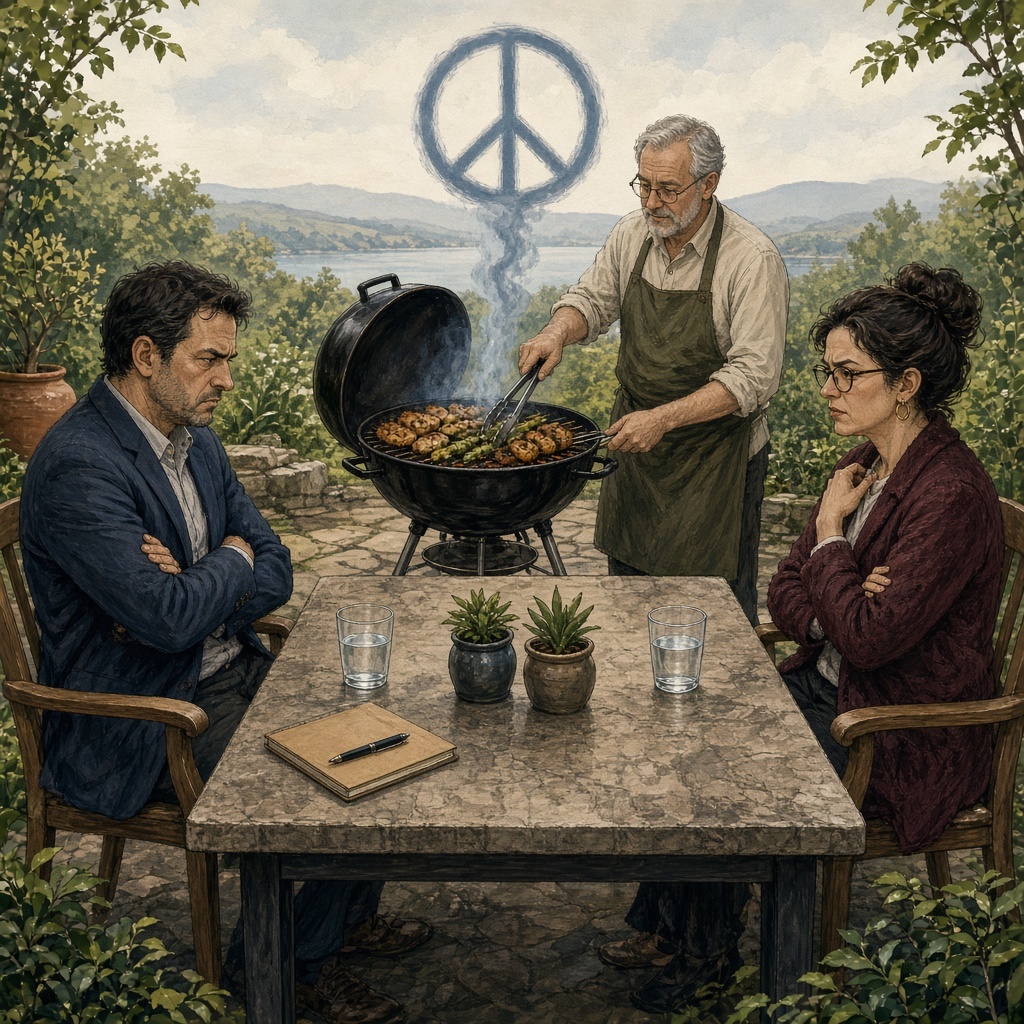
Not long ago, I was also out for a neighborhood walk and--to my wife's consternation--mulling over the ingredients for a successful mediation. Three seemingly unrelated ideas spanning decades of popular culture in psychology, television and music made their way into my wandering mind: the stages of anger and grief, the wisdom of TV's Ted Lasso and the hope of John Lennon. Together, they suggest a simple truth about mediation: Meaningful resolution often requires time for conflict to cool, as well as patience and trust in the process, to yield the best chance for peace. Deciding against carving my thoughts into a neighbor's fence or otherwise defacing a nearby property, I sat down and started typing after I arrived home.
Anger and conflict: Most of us are familiar with theories describing stages of grief or anger. Published in 2001, "The Angry Child: Regaining Control When Your Child is Out of Control," by Dr. Timothy Murphy and Loriann Hoff Oberlin, for example, offers a four-stage model of anger: (1) The Buildup: the frustration, hurt feelings and unresolved conflicts accumulating over time; (2) The Spark: some event, often quite minor, that awakens the underlying tension; (3) The Explosion: the eruption of the tension into open conflict; and "probably the most important stage" per Murphy and Oberlin, (4) The Aftermath and the Opportunity for Resolution: what Murphy and Oberlin describe as "probably the most important stage," involving working through damaged relationships toward reconciliation and a more favorable future. This teaching of Murphy and Oberlin confirms what many mediators observe. Parties often arrive at mediation carrying years of frustration, disappointment and perceived injustice. Before they can evaluate settlement and realistically discuss numbers, options or business realities, more often than not, they need an opportunity to be heard, understood and acknowledged.
Barbecue: More recently, my wife and I returned from another neighborhood walk and were watching the 2026 season of "Ted Lasso." Ted--now coaching a women's soccer team in London--also is mentoring the team's assistant coach, who does not mince words when coaching the players. After one particularly difficult exchange, Ted offers her his tips for successful barbecue:
See, when I first started learning, I was always in a rush. Just lifting that lid, poking the meat, jacking that heat all the way up because I was impatient and hungry. Well, you know what happens? The meat gets all tough. I'd end up cooking all the tenderness right out of it. I kind of find that people are the same way. You know, you poke them and prod them every five minutes, they can get a little chewy. But if you trust the process, keep the temperature nice and steady, add a little spice when necessary and a little sauce to keep it sweet, well, you got a good shot of ending up with something you're gonna be proud of.
"Ted Lasso," Season 4, Episode 5.
Bed-in: Many years earlier, in 1969, when the Beatles were on the verge of breaking up, John Lennon and Yoko Ono staged a "bed-in" for eight days in room 1742 of The Queen Elizabeth hotel in Montreal to promote world peace. Joined by a number of celebrities, including Tommy Smothers, Petula Clark and Timothy Leary, they received significant media attention. They also recorded Lennon's song "Give Peace a Chance." It was released as Lennon's first solo single (with the Plastic Ono Band) and became an anthem of the anti-war movement in the 1970s.
At this point, you may be wondering: What is going on in Scherling's head while he's out for those neighborhood walks, and what does any of this have to do with successful mediation?
As most of us know and as reflected in the work of Murphy and Oberlin with respect to anger, most conflicts do not arise overnight. They may involve actual or perceived wrongs arising and simmering over days, weeks, years and even decades. In our legal world, eventually something brings conflict to the surface, then to lawyers and ultimately into the courthouse. The teachings of Murphy and Oberlin confirm what we as mediators see time and time again: The parties, more often than not, need to work through these stages of anger before they can rationally focus on resolution and move on with their lives. And this takes time.
Ted Lasso's lesson about great BBQ builds on the same idea. Mediation, like great BBQ, cannot be rushed. Too much heat too soon can lead to ruin. As Ted aptly stated, the parties need to "trust the process," smoothing rough edges with a little "sauce" and adding just the right amount of "spice" when needed.
And all this means, as John Lennon rather elegantly stated, is "give peace a chance."
Many of us have been in mediations in which settlement appeared unlikely after many hours. The parties may have started to abandon hope and even considered walking out after a few frustrating exchanges.
But then the magic of mediation starts to work. At some point, anger evolves into pragmatic and realistic thinking, the parties start to anticipate the aroma of a good settlement wafting through the conference room and a resolution that seemed nearly impossible only a few hours ago is at hand. Conflict gives way to peace. As John Lennon reminded us decades ago, the parties just have to give it a chance.
In the meantime, enjoy that next neighborhood walk.
Submit your own column for publication to Diana Bosetti
For reprint rights or to order a copy of your photo:
Email
Jeremy_Ellis@dailyjournal.com
for prices.
Direct dial: 213-229-5424
Send a letter to the editor:
Email: letters@dailyjournal.com